substack vs beehiiv · Oct 21, 2026
Substack vs Beehiiv: Which Platform Fits Your Newsletter?
A newsletter platform that takes a share of revenue can still be the better business decision if it brings customers the publisher wouldn't otherwise reach. Substack's internal network can be a meaningful source of new readers, although no network figure is a forecast for any individual publication.

A newsletter platform that takes a share of revenue can still be the better business decision if it brings customers the publisher wouldn't otherwise reach. Substack's internal network can be a meaningful source of new readers, although no network figure is a forecast for any individual publication. Substack generally fits writers seeking discovery and low initial commitment; beehiiv fits publishers seeking deeper reporting and growth operations. The deciding factor isn't the feature count. It's how the publication acquires readers, earns money, and retains usable customer data.
Table of Contents
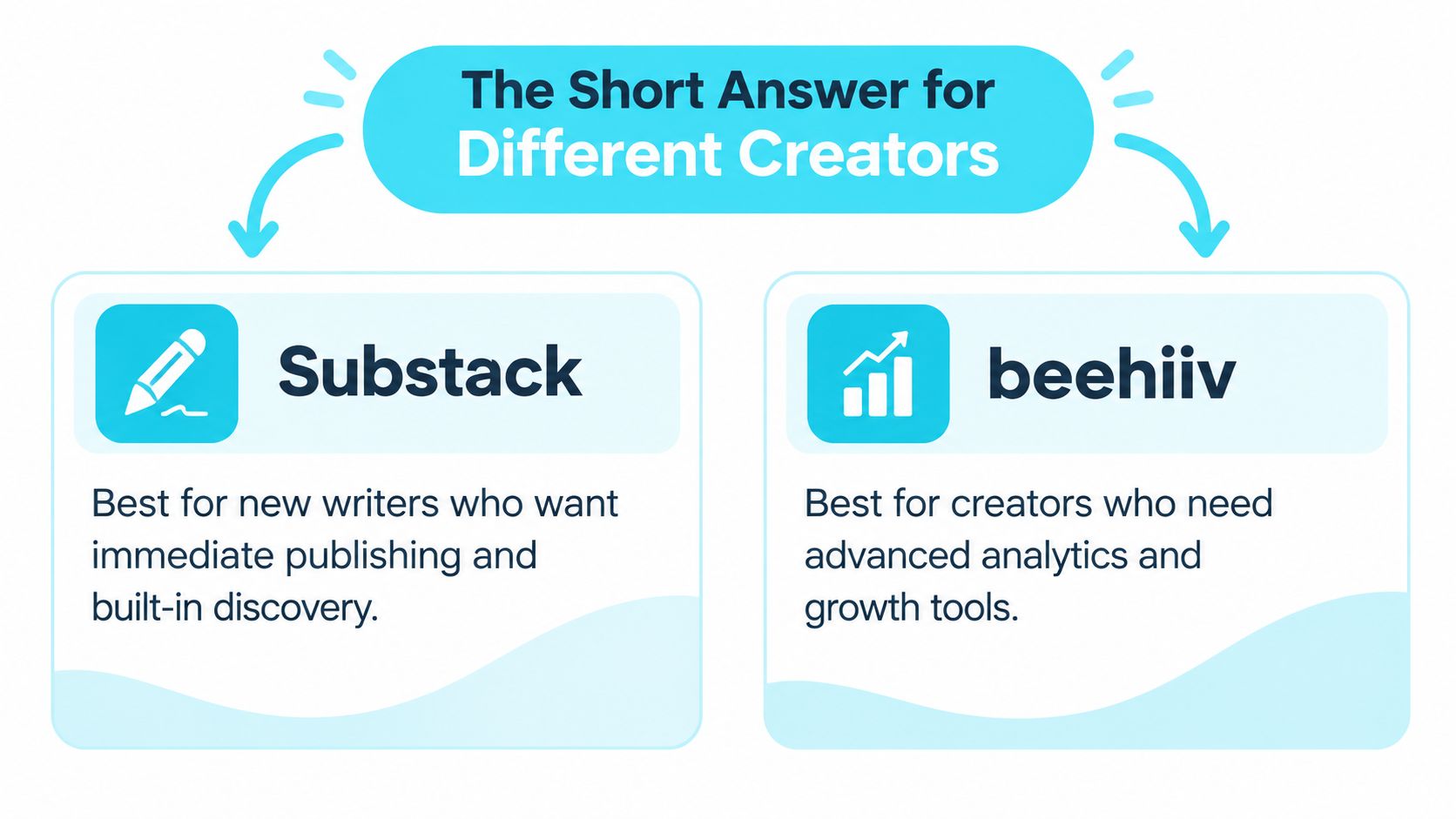
The Short Answer for Different Creators
Substack favors discovery and a straightforward publishing workflow. Beehiiv favors software-style controls and newsletter-business operations. These are useful starting points, not permanent labels for beginners and professionals.
A writer testing whether readers will pay has a different problem from a publisher deciding which acquisition channel deserves more investment. The former needs evidence of demand. The latter needs evidence about where profitable demand comes from.
Decision criterion | Substack | beehiiv |
|---|---|---|
Main attraction | Publishing inside a discovery network | Operating a newsletter with more granular reporting |
Early-stage priority | Testing an editorial proposition | Building a repeatable acquisition process |
Measurement emphasis | Core publication performance | Sources, segments, and revenue performance |
Main question before choosing | Will the network bring relevant readers? | Will the controls improve actual decisions? |
The distinction between basic metrics and more detailed operational reporting is supported by beehiiv's newsletter-platform comparison. Because that's a vendor-authored guide, its comparisons deserve consideration rather than automatic acceptance.
What Can Reverse the Recommendation
An existing audience changes the acquisition problem. A business already attracting readers through its website may value source reporting more than access to another discovery channel.
Revenue mix changes the economics. A premium publication and a free, sponsor-funded newsletter shouldn't use the same cost assumptions.
Portability changes the risk calculation. A publisher expecting to change systems should investigate export quality before committing.
The useful distinction isn't amateur versus professional. It's finding an audience versus operating an audience business. Some established writers still benefit most from discovery, while some new businesses need segmentation and attribution from the outset.
How the Two Platforms Work
Substack combines a publication with a wider reader network. Beehiiv is more explicitly a software platform for publishers. That difference affects what operators should expect from each product.
Substack launched in 2017 and grew to 5 million paid subscriptions in March 2025, and it has since added Notes and a short-form video feed, according to coverage of Substack's development and competitive position. Those developments matter because Substack is more than an email editor with a payment button. A publisher participates in a service where readers can encounter publications outside their inbox.

A Publication Inside a Network
For a Substack writer, publishing and audience development can overlap. The operational question becomes whether activity inside that environment attracts readers who value the publication's core work.
Network participation still requires judgment. A writer should distinguish attention around a short post from a subscription relationship, and a subscription relationship from a paying customer. Those aren't interchangeable business outcomes.
A useful evaluation would ask whether network-acquired readers return, respond, and eventually support the publication. Network size alone can't answer that.
A Newsletter Operated as a Business
Beehiiv's product orientation puts more emphasis on acquisition tooling, referral mechanisms, segmentation, and revenue reporting. Its appeal is less about eliminating operational work than giving a publisher more ways to organize that work.
For example, a specialist newsletter might want to compare readers arriving through partner recommendations with readers arriving through a business website. The meaningful result isn't which source produces more signups. It's which source produces readers worth retaining.
A longer feature list has little value when the publisher can't name the decision each feature will support.
Both approaches can support a serious publication. The right comparison depends on whether the creator is building a writer-led destination, an instrumented newsletter business, or a broader site whose newsletter is only part of the customer relationship.
Pricing, Fees, and the Break-Even Point
The pricing comparison starts with different kinds of risk. Substack ties its platform charge to paid-subscription revenue. Beehiiv's paid plans create a recurring software commitment.
Substack is free to publish without paid subscriptions, regardless of subscriber count. Once a publication earns subscription revenue, its platform fee is 10%, with separate Stripe charges listed as 2.9% plus $0.30 per transaction and 0.5% for recurring subscriptions, according to Substack's paid-subscription explanation.
Beehiiv's advertised starting prices depend on subscriber tier and billing commitment. Its published email-marketing pricing lists a free plan supporting 2,500 subscribers with unlimited sends, Lite from $49 monthly with annual billing or $59 month to month, and Pro from $95 annually billed or $109 monthly, with those paid starting prices applying at the 1,000-subscriber tier.
Substack vs Beehiiv Cost Comparison
Criterion | Substack | Beehiiv |
|---|---|---|
Free publishing | No platform fee without paid subscriptions | Free entry plan with a subscriber limit |
Paid-plan structure | Revenue-linked platform charge | Plan fee affected by tier and billing terms |
Subscription-revenue treatment | Percentage platform fee | No platform share of paid subscriptions |
Payment processing | Separate from the platform charge | Separate from the plan fee |
Main cost risk | Commission increases with subscription revenue | Required plan can become more expensive as needs change |
Beehiiv states that it takes 0% of paid-subscription revenue, while listing standard Stripe processing separately at 2.9% plus $0.30 per transaction on its pricing page. No platform commission doesn't mean no transaction costs.
What the Break-Even Calculation Actually Shows
For a publication generating $1,000 in monthly gross subscription revenue, Substack's platform share alone is $100. Using beehiiv's published Lite starting price of $49 monthly with annual billing or $59 month to month, the simplified crossover against a 10% commission sits at roughly $490 to $590 in monthly subscription revenue, before processing, taxes, plan differences, or subscriber growth.
That range illustrates the calculation, not a universal switching threshold. Beehiiv's prices rise with subscriber count, so an operator must use the actual eligible plan rather than assume the entry price remains applicable.
The calculation is straightforward: divide the relevant fixed platform charge by the commission rate being avoided. Then add the costs the simplified comparison omits.
Required functionality: The cheapest plan matters only if it supports the intended business.
Billing commitment: An annually billed monthly equivalent isn't the same cash commitment as monthly billing.
Supporting software: Analytics, automation, hosting, and integrations belong in the budget.
Acquisition value: A lower software bill isn't automatically a better outcome if it removes a productive customer source.
The financial question is therefore broader than which platform charges less. It's whether the savings survive after the publisher replaces any useful discovery, tooling, or workflow.
Sending, Deliverability, and Audience Controls
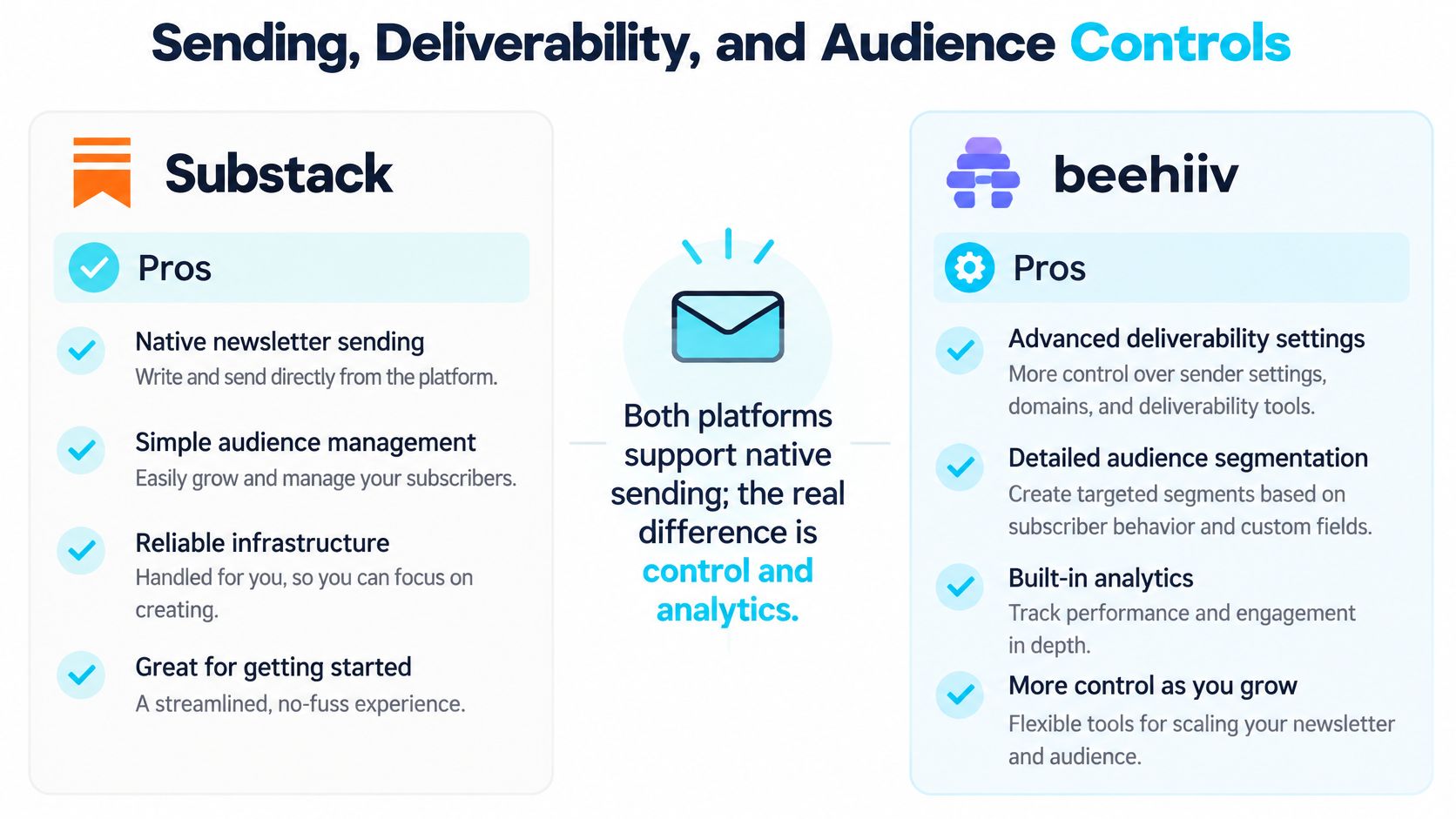
Sending a newsletter and operating a dependable audience system aren't the same task. Both products support newsletter publishing, but the operator still needs to understand who receives each message, where those readers came from, and what happens afterward.
Substack's core reporting and beehiiv's more granular reporting were distinguished earlier. Operationally, that difference matters when a publisher needs to act on a specific group rather than inspect publication-wide averages.
Why Open Rates Can't Settle Deliverability
The available third-party open-rate comparison uses different send counts and a narrow freelance-technology audience. It isn't a controlled test, so it shouldn't support a blanket claim that either platform delivers better for every publication.
An operator should also separate inbox placement, engagement, and commercial response during evaluation. They answer different questions: whether a message arrived where expected, whether readers interacted, and whether that interaction supported the business.
A sensible test would use the publication's own content and audience. Switching platforms, redesigning the newsletter, and changing the publishing schedule simultaneously would make the result harder to interpret.
Practical rule: A platform-wide average shouldn't outweigh repeatable evidence from the publication's own subscribers.
An Operational Evaluation Checklist
Inbox placement: Send representative messages to test accounts and inspect actual placement rather than treating opens as a substitute.
List hygiene: Establish how unsubscribes, invalid addresses, and inactive readers will be handled.
Source attribution: Use consistent UTM conventions so partner, search, social, and paid campaigns remain distinguishable.
Cohort tracking: Compare readers acquired through the same channel during the same period.
Conversion measurement: Connect acquisition sources to paid membership or another defined business outcome.
Workflow effort: Record which tasks require exports, spreadsheets, or manual reconciliation.
For publishers developing these routines, LearnStream's resource on managing subscriber growth for memberships is a relevant companion to the platform evaluation. The useful exercise is translating list-management needs into a workflow that can be demonstrated, not checked off on a feature list.
Consider a business newsletter serving prospective customers and existing members. A publication-wide engagement result doesn't answer whether those groups need different messages. The operator should test whether the chosen system can identify the groups, support the intended communication, and report the outcome.
Extra reporting is only valuable when someone uses it. A small editorial team that won't maintain attribution conventions may get less benefit from advanced controls than the product comparison suggests.
Subscriptions, Sponsorships, and Digital Products
A subscription publication sells continuing access. A sponsorship-led newsletter sells an advertiser access to an audience. A creator selling digital products needs to connect editorial attention with a separate purchase decision.
Those models require different calculations. Comparing subscription commissions alone can obscure the costs that matter most to an advertising or product-led business.
Premium Subscriptions
For a writer testing a paid editorial proposition, the important uncertainty is whether readers want the offer. Substack's revenue-linked model can suit that experiment because platform spending follows subscription income rather than preceding it.
For a publisher with established recurring revenue, the earlier fee comparison becomes more relevant. Even then, a decision should include the value of customers acquired through the platform, not treat every subscription as independent of its environment.
The operator should ask which paid readers would probably have subscribed through another channel. That counterfactual can't be measured perfectly, but ignoring it gives an incomplete view of net value.
Sponsorship and Product-Led Revenue
Beehiiv's referrals, recommendations, Boosts, advertising network, and sponsorship-related tooling broaden the operational comparison beyond subscriptions. Those mechanisms should be evaluated separately because they can serve different purposes, including acquisition and monetization.
Beehiiv describes built-in earning systems such as Boosts and the beehiiv Ad Network in its review of the newsletter business in 2025. Their presence demonstrates activity within the network, not likely earnings for a particular publisher.
Revenue model | Operational questions |
|---|---|
Premium subscriptions | Which readers convert, renew, and remain profitable to acquire? |
Sponsorships | Who finds advertisers, prepares placements, approves copy, and reports results? |
Digital products | How are purchases connected to editorial content and customer records? |
Hybrid publication | Which activities share infrastructure, and which require separate work? |
For a creator assessing commerce alongside editorial publishing, the guide to selling products on a blog without Shopify provides a relevant route for examining the wider publishing stack.
A sponsorship operator should budget for sales effort, available inventory, placement charges, payment costs, and reporting. A product seller should investigate checkout, delivery, customer support, and access to purchase records rather than assuming a favorable commission policy resolves those questions.
Net revenue after the full stack is the useful comparison. A platform can charge less on subscriptions while creating other operating costs, or charge more while supplying a productive acquisition channel. Neither outcome can be determined from the headline commission alone.
Portability, Site Control, and Platform Dependence
Portability deserves a practical test before a publisher needs to leave. An export button isn't enough evidence that another system can reconstruct the publication's archive, audience records, and operating history.
The Substack vs beehiiv decision involves distinct kinds of dependence. A publication can depend on a network for discovery, on software for its workflows, or on historical data for understanding customers. Changing systems may affect each relationship differently.
What a Migration Test Should Cover
Rather than assume either platform satisfies every requirement, an operator should request a sample export and examine what survives.
Editorial archive: Check post bodies, formatting, publication dates, media, and attachments.
Subscriber records: Inspect subscription status, consent information, custom fields, and source history where available.
Paid relationships: Confirm how memberships and payment relationships would continue in the destination system.
Site continuity: Investigate domains, redirects, navigation, and links to older content.
Integrations: Verify the required API operations and connections rather than accepting API access as a complete answer.
The guide to subscriber-owned newsletters versus Substack is relevant for evaluating the difference between platform participation and control over the broader publishing system.
For a wider perspective, Expert Author Community's book on owning your media offers a useful starting point for considering what a creator should retain independently. The practical question remains specific: what can the business continue using if a platform relationship ends?
Independence is easier to assess through a successful export and restore than through an ownership slogan.
Site Control Isn't the Same as Audience Control
A publication might be comfortable participating in a network while still needing its own domain and archive. Another might prioritize customer records and integrations over extensive visual customization.
Theming should therefore be tested against actual page requirements. A small business may need service pages, a publication archive, signup forms, and membership access to work together. The relevant comparison is whether each candidate supports that arrangement without unacceptable manual work.
VeloCMS is one alternative for publishers considering a combined blogging, newsletter, membership, and theming platform. It includes native email delivery, audience segments, integrations, API access, and exports of every post, member, media file, and setting as JSON, CSV, or Markdown; it is subscription-based, has no free plan, and every plan starts with a 14-day free trial, as outlined in its platform and pricing information.
That alternative doesn't remove the need for testing. A publisher should still verify the destination's imports, inspect a restored archive, and confirm that essential customer records remain usable.
Choose by Creator Situation
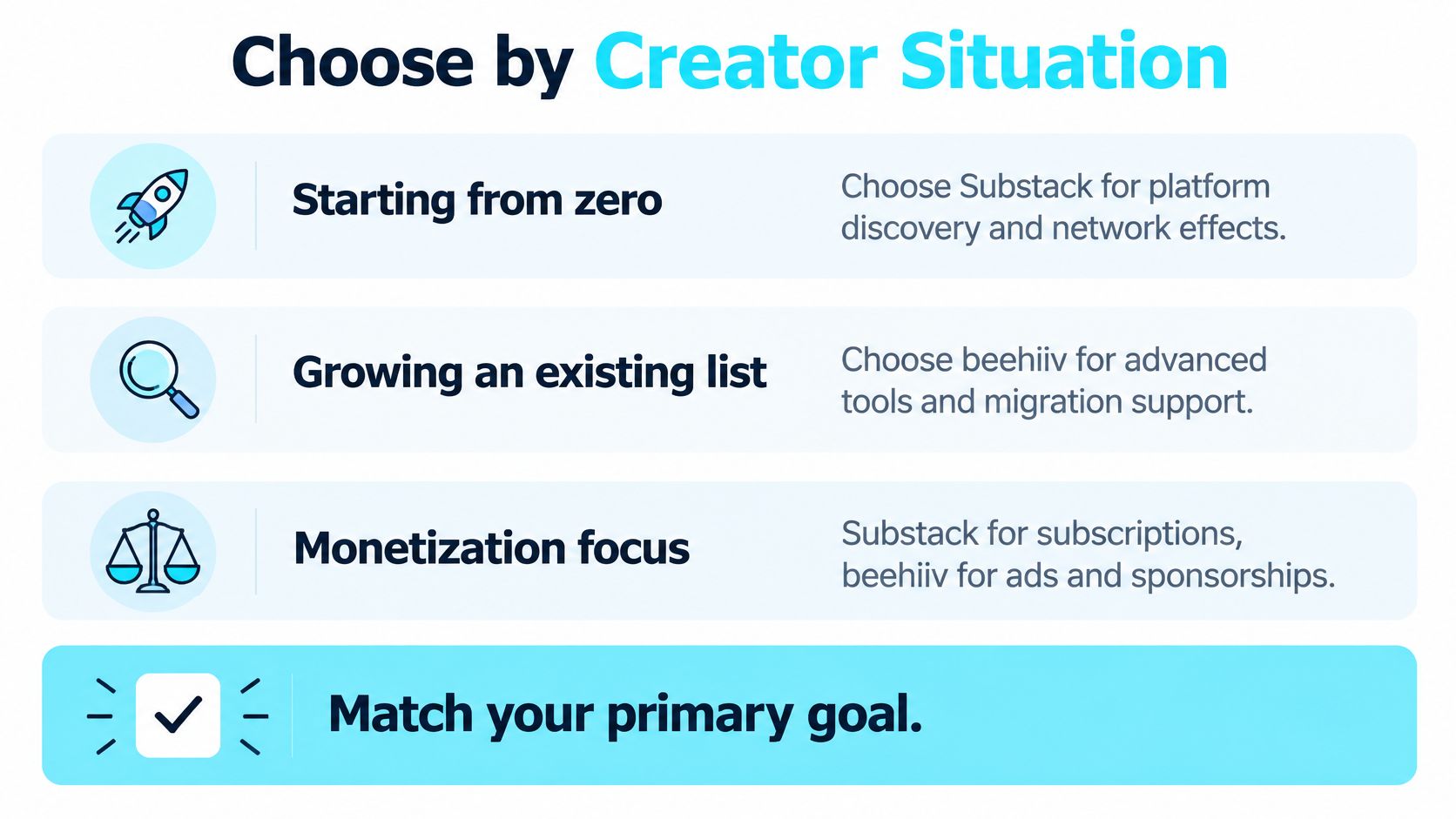
A useful platform recommendation begins with the publication's next difficult decision. A creator searching for initial readers needs different evidence from an operator deciding how to allocate an acquisition budget.
Starting Without an Established Audience
A new essayist could reasonably test Substack first. The experiment should examine whether network participation attracts readers interested in the paid proposition, not merely whether it generates attention.
The evidence to collect includes signup sources where visible, reader responses, repeat engagement, and willingness to subscribe. A quick launch isn't proof of a sustainable publication.
Operating an Existing List
A specialist publisher with established distribution could reasonably favor beehiiv when channel-level measurement would change spending or editorial decisions. The test should begin with a real question, such as whether partner-acquired readers become better customers than social-acquired readers.
For a monetization-focused creator: Compare the intended revenue streams and the work required to operate them.
For a small business or agency: Test the connection between website content, subscriber records, memberships, and existing systems.
For a publisher considering alternatives: Include a destination assessment rather than treating departure from the current service as the objective.
An operator preparing a move can use the guide to switching from Substack to a self-hosted blog to frame migration questions. The decision should follow evidence about the destination, not frustration with the current platform alone.
The Final Decision Checklist
A defensible choice connects platform capabilities to business decisions. More features won't help a publisher who lacks a clear acquisition model, while a simple workflow won't resolve an established business's reporting needs.
Before committing, the operator should be able to answer the following questions with evidence rather than preference.
Business Fit
Acquisition: Does the publication need help finding readers, or better measurement of channels it already operates?
Costs: Which applicable plan and supporting tools are required for the intended workflow?
Revenue mix: Will the business depend on memberships, sponsorships, products, or a combination?
Reporting: Which recurring decisions require source, segment, retention, or revenue data?
Site requirements: Can the publication's content, signup journey, and customer relationships work together?
Portability: Has an actual export been inspected and tested in a plausible destination?
Validation Before a Switch
A migration-minded publisher should preserve the audience and archive before changing systems. The destination should then be checked for missing content, subscription status problems, broken links, and gaps in reporting continuity.
After the move, the operator should compare acquisition and conversion against the previous baseline. Revenue, retention, acquisition cost, and operating effort should be monitored across several reporting periods, with unrelated changes kept visible.
Substack is a sensible starting point when discovery and low initial commitment dominate. Beehiiv is a sensible choice when newsletter growth operations and reporting dominate. An integrated owned-site platform deserves consideration when the newsletter must function alongside a broader content and customer system.
The strongest choice is the one whose advantages the publisher can use, measure, and afford to lose.
VeloCMS combines blogging, newsletters, memberships, and site theming with native email delivery and portable content and audience exports. Publishers comparing newsletter software with a broader content platform can visit VeloCMS and use its trial to test a publishing workflow, audience segments, and exports before committing.