SEO writing tools · Oct 11, 2026
10 SEO Content Writing Tools Compared for Small Teams
The first organic result gets 27.6% of clicks, while only 0.63% of searchers click a result on the second page, so SEO content writing tools should improve more than grammar or word count. No single tool does every SEO writing job well, so choose by the step that slows you down most, drafting, resea
The first organic result gets 27.6% of clicks, while only 0.63% of searchers click a result on the second page, so SEO content writing tools should improve more than grammar or word count. No single tool does every SEO writing job well, so choose by the step that slows you down most, drafting, research, grading or publishing, and by your budget.
Could a polished AI draft still fail because nobody checked its search intent, page structure, schema or publishing path? That gap explains why the best tool depends on the workflow, not the logo. Some platforms help create a first draft. Others research competing pages, grade topical coverage, recommend links or schema, simplify dense prose, or publish the finished article alongside newsletters and memberships.
The options below map each product to a specific writing job. The trade-offs matter for a small site. A credit limit can restrict a busy editorial calendar. A broad SEO suite can cost more than a focused editor. An AI writer can save time but still produce generic or unsupported claims. A CMS can reduce tool switching but offer fewer specialist integrations than WordPress.
The study behind those click figures analyzed 1,312,881 pages and 12,166,560 queries, which reinforces a practical point: optimization works best before publication, while headings, entities, links and structured data can still change. Teams comparing AI content optimization tools should therefore start with the publishing bottleneck, then test whether the tool improves the complete workflow.
Table of Contents
1. VeloCMS
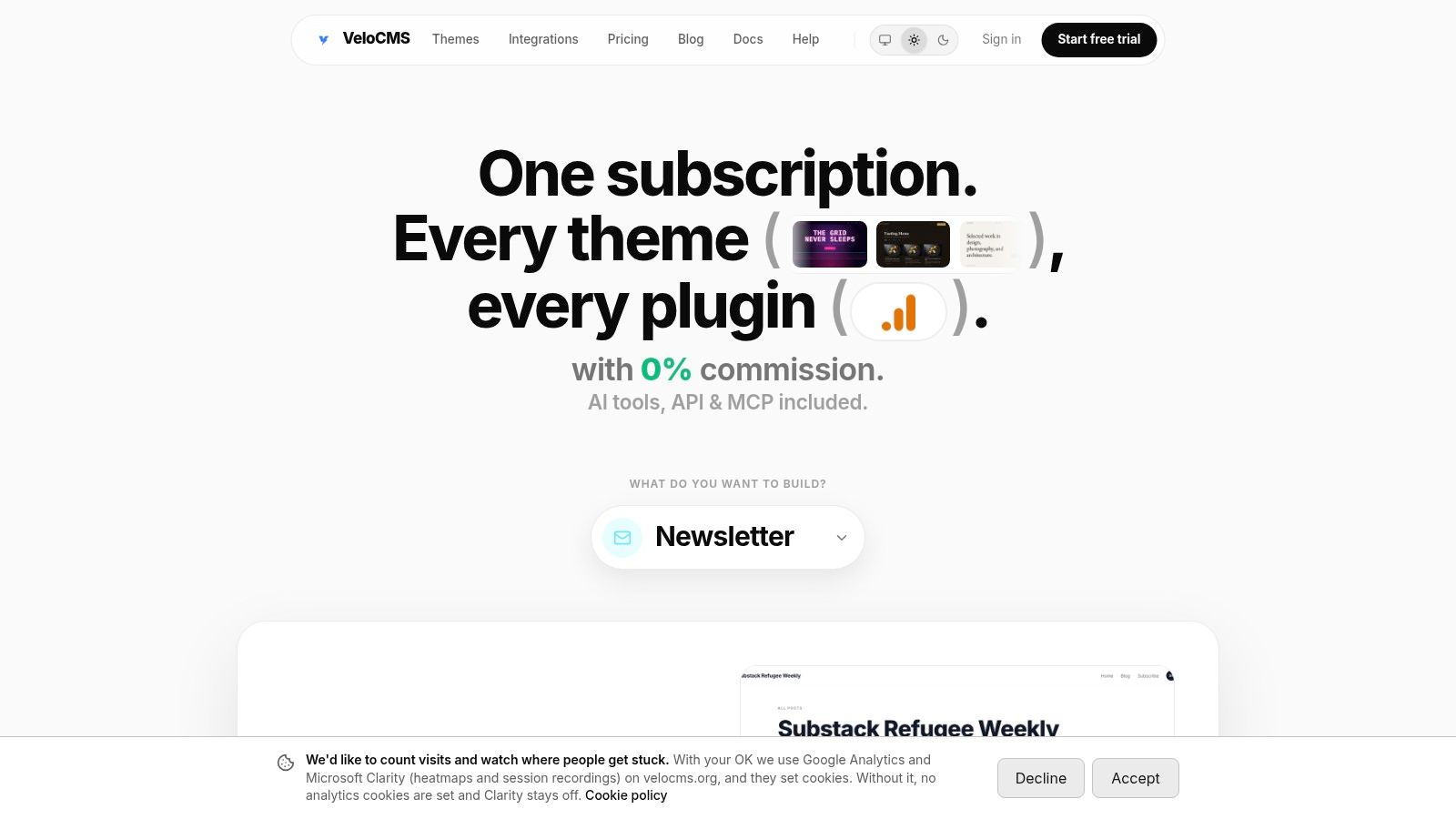
VeloCMS fits writers who want SEO feedback and publishing in the same workspace. Its block editor includes slash commands and AI rewrite support, while live SEO scoring, schema assistance and content-gap hints help shape a draft before it goes live. That makes it more than a text generator. It connects writing with the practical work that follows, including newsletters, memberships, commerce and site theming.
Best for replacing a fragmented stack
The strongest use case is a creator or small team tired of combining a CMS, SEO plugin, newsletter provider and membership tool. VeloCMS includes native newsletter delivery with segments, tags and automations, paid memberships, commerce, a theme library of 40 themes, API access and webhooks. It also connects with Kit, Mailchimp and Zapier without separate connector fees.
Migration is another practical advantage. Importers support WordPress, Ghost, Substack, Squarespace and Medium, while complete Markdown and JSON exports cover posts, members and media. That portability matters for a small business that doesn't want its content trapped in one system.
Practical rule: Choose VeloCMS for fewer moving parts, not because an integrated platform can replace every specialist tool.
The trade-off is ecosystem depth. WordPress has more third-party plugins, so an unusual feature may require custom development in VeloCMS. The platform also has no permanent free tier. Every plan starts with a 14-day free trial, and you are not charged if you cancel before day 15. Annual pricing shown on the site lists Pro at about $7.20 per month, Business at about $23.20 per month and Agency at about $55.20 per month, so readers should verify current details on the VeloCMS pricing page.
VeloCMS also describes an internal desktop LCP target of about 0.8 seconds, but that's an internal target, not an independent benchmark. Google recommends LCP within 2.5 seconds and classifies results above 4 seconds as poor, so writers should still check images, embeds and scripts after publishing through Google's Core Web Vitals guidance.
Pros: Integrated editor, AI SEO scoring, schema help, newsletters, memberships and commerce; migration tools; full exports; 0% platform commission; predictable subscription structure.
Cons: No permanent free plan; smaller plugin ecosystem; performance targets still need independent validation.
2. Clearscope
Clearscope is best at grading and standardizing content quality. A writer enters a target topic and receives SERP-driven term and outline guidance while working in a writer-focused editor. The value isn't just a score. Editors can see whether a draft covers the concepts that competing pages address, then decide which missing ideas actually belong in the article.
Best for reliable content grading
The platform suits mid-market and enterprise teams that need consistent review across several writers. Brief building, competitor term benchmarking, content drafts and inventory workflows support a repeatable production process. Reporting also helps agencies explain recommendations to clients without turning every review into a manual SEO lesson.
Clearscope has expanded beyond traditional Google-focused optimization with AI search visibility tracking for answers and citations. That direction fits teams asking whether their pages appear in generated search responses, but visibility data shouldn't replace human review of usefulness, originality and factual support.
A separate guide to writing blog posts that rank in Google and AI search is useful alongside the tool because a high content grade doesn't prove that a page answers a reader's real decision.
The main limitation is cost and capacity planning. Clearscope is positioned above many small-business tools, and its credit model can feel restrictive for teams producing large volumes. It also won't replace a full CMS, email system or technical audit platform.
Pros: Accurate-feeling grading, quick writer adoption, strong reporting and useful AI search visibility tracking.
Cons: Premium positioning, credit-based usage and limited value for a writer who only needs basic readability or grammar feedback.
See the current product details on the Clearscope pricing page.
3. Surfer SEO
Surfer SEO works well when the job is turning SERP research into an editable draft. Its Content Editor combines a live SEO score with NLP term suggestions, structure targets and outline support. A writer can use the recommendations while drafting, or apply them to an existing article that needs clearer topical coverage.
Best for drafting and updating pages
Surfer also connects keyword research with content planning, site audits and content audits. That broader workflow appeals to agencies because the same platform can support a new brief and a refresh of an older URL. Non-SEO writers benefit from the checklist format, although the recommendations still require judgment. Adding every suggested term can make copy awkward and repetitive.
AI visibility and monitoring features add another layer for teams tracking how their content appears in AI search environments. The tool remains strongest when a team already understands its target audience and uses the score as a diagnostic rather than a writing target.
The VeloCMS explanation of SEO and LLM scores provides useful context for readers comparing a numeric score with broader editorial quality.
Surfer's main drawback is complexity. Pricing and credits can be difficult to forecast because document usage affects consumption. New users may also need time to learn which recommendations matter for a particular search intent and which reflect patterns rather than requirements.
Pros: Mature content editor, useful audits, keyword planning and strong support for both new and existing content.
Cons: Credit and pricing complexity, a learning curve and the risk of writing for the score instead of the reader.
Visit Surfer SEO for current plan information.
4. MarketMuse
MarketMuse is the strategic option in this list. It looks beyond one draft and helps teams decide which topics deserve attention across a larger site. Topic modeling, content-gap analysis and inventory views can reveal missing subtopics, overlapping pages and opportunities to build stronger topical coverage.
Best for content roadmaps
A page-level editor provides subtopic coverage scoring, but the more important use case is prioritization. Teams can compare pages, assess competitive gaps and model topic value before assigning work. That makes MarketMuse a better fit for a content strategist managing a broad editorial roadmap than for a solo blogger looking for a quick outline.
The platform's visual reporting can also help secure internal support. A marketing lead can show why an existing page needs updating or why several related articles should be planned together. That decision-making layer is harder to get from a simple content grader.
MarketMuse does demand more setup and interpretation than a lightweight editor. Solo users may find the interface excessive if they publish occasionally. Its pricing has historically been oriented toward teams, so small businesses should confirm current packaging before building a workflow around it.
The tool also can't determine whether a topic is genuinely valuable to a specific audience. It can expose gaps and patterns, but a subject-matter expert still needs to add experience, examples and a clear reason for the page to exist.
Pros: Deep topic planning, inventory analysis, content-gap research and useful visualizations for prioritization.
Cons: Higher learning curve, team-oriented positioning and less immediate value for low-volume publishing.
Current plans are listed on MarketMuse.
5. Frase
Frase is built for speed from keyword to brief to draft. Its SERP analysis surfaces competing-page patterns, common questions and content gaps, then turns that research into an outline. The integrated AI writer can follow the brief, which reduces the need to move between separate research and drafting tools.
Best for approachable AI-assisted drafting
Small teams often choose Frase because the workflow is easy to understand. A non-technical writer can see what an article should cover, generate a starting draft and optimize the page in one interface. FAQ and answer research can also help when a topic needs clear responses to related questions.
The weakness appears after the first draft. AI-generated prose can sound generic, especially when the writer accepts the outline and wording without adding firsthand examples, specific evidence or a distinct point of view. A content score may improve while the article remains interchangeable with competing pages.
That matters because Google recommends people-first content that is reliable, readable, organized, unique and current. Its SEO Starter Guide also advises natural writing, clear sections and avoiding material that merely copies or rehashes other pages.
The VeloCMS AI writing assistant offers a useful comparison point for teams deciding whether AI drafting should live inside a publishing platform or a specialist optimization tool.
Pros: Fast brief-to-draft workflow, approachable interface, useful SERP and FAQ research and good value for smaller teams.
Cons: Generic output without editing, less strategic depth than MarketMuse and a risk of treating AI completion as finished content.
See Frase for current plans.
6. Semrush SEO Writing Assistant
Semrush SEO Writing Assistant suits teams already using Semrush for keyword research, competitor analysis and measurement. It brings SEO, readability, tone and content-score checks into Google Docs, WordPress and the Semrush interface. That reduces handoffs for teams that already keep their research in the Semrush ecosystem.
Best for connecting research and measurement
The recommendations draw on Semrush keyword and SERP data, while collaboration features support editorial review. The wider Content Toolkit can connect content work with analytics and Google Search Console or Google Analytics data, giving marketers a path from brief to post-publication measurement.
That breadth is both the strength and the limitation. A Semrush user may appreciate the single ecosystem, but a small blogger who only needs content grading could pay for far more than the writing assistant. Full access requires a Semrush subscription, and costs can add up as the team adds other research and reporting functions.
The tool is also less specialized than a dedicated content editor. It can flag issues, but writers may need another product for deep topic modeling, a separate CMS for publishing or a dedicated schema workflow. It works best as one layer in a larger marketing stack.
Pros: Convenient for existing Semrush customers, strong research-to-writing handoff, Google Docs and WordPress integrations and broad reporting connections.
Cons: Subscription dependency, potentially high total cost and less depth than specialist optimization platforms.
Review the current Semrush Content Toolkit plans before committing.
7. Content Harmony
Content Harmony focuses on research and briefs rather than finished prose. Its workflow combines SERP snapshots, search intent, competitor analysis and term coverage into exportable documents that writers can use in the editor of their choice.
Best for repeatable briefs
This separation works well for agencies and teams with a clear division between SEO research and writing. A strategist can create a brief that explains the audience, purpose, structure and coverage requirements. Several writers can then work from a consistent document without needing access to the same writing environment.
Content Harmony includes unlimited users and projects on every plan, which makes it practical for client work. The deliverable is easy to review with non-SEO stakeholders because it presents the reasoning behind a brief instead of only displaying a score.
The trade-off is obvious. Content Harmony isn't a complete writing environment. Writers must move the brief into Google Docs, a CMS or another editor, then return to the source when questions arise. That extra handoff may be acceptable for an agency, but it can feel unnecessary for a solo publisher.
The credit model also requires planning. Credits roll over, but high-volume teams still need to forecast monthly brief demand before selecting a plan.
Pros: Strong brief process, clear deliverables, useful intent research and agency-friendly collaboration.
Cons: No full drafting environment, credit planning and additional tool switching for writing and publishing.
Explore Content Harmony to assess the current workflow.
8. NEURONwriter
NEURONwriter targets writers who want SERP-based optimization without enterprise-level planning features. Its content editor provides real-time scoring, NLP term suggestions, heading guidance, outline tools and AI writing tools.
Best for budget-conscious optimization
The product makes sense for freelancers and small agencies that need practical content signals. A writer can enter a target query, review competing-page patterns and use the suggestions while drafting. The interface is less intimidating than some larger platforms, so a small team can start using it without building a large editorial operation first.
Its affordability is also its main appeal, although current plan details and trial options should be checked directly. Analysis and report limits mean that a growing content calendar needs volume planning. A cheap subscription can become frustrating if writers run out of the reports needed for client work or frequent updates.
NEURONwriter doesn't provide the inventory-level strategy of MarketMuse or the publishing stack of VeloCMS. It also can't verify whether an AI-generated claim is true. Human editors still need to check sources, remove unsupported generalizations and add experience that the model couldn't know.
Pros: Strong value for cost-sensitive teams, useful live optimization signals, built-in outline support and a manageable learning curve.
Cons: Fewer enterprise planning features, report limits and AI output that still needs factual and editorial review.
Current product information is available at NEURONwriter.
9. PageOptimizer Pro
PageOptimizer Pro, usually called POP, takes an engineering-style approach to on-page optimization. It benchmarks a page against competitors across more than 100 on-page signals, then gives priority guidance for specific fixes. That makes it useful when a writer or site owner wants a concrete repair list instead of broad advice.
Best for prescriptive page improvements
POP is particularly helpful for existing pages. A site owner can identify missing structural elements, compare the page with ranking competitors and work through recommended changes. POP Pilot explains what to fix and why, while the AI Visibility Tracker adds monitoring for AI search citations and mentions.
The narrow focus is a benefit for some teams. A non-SEO writer can follow the recommendations without learning a complete SEO suite. Transparent competitive benchmarking also makes the output easier to challenge. Writers can reject a suggestion when it damages clarity rather than blindly applying every instruction.
POP won't replace keyword discovery, a full editorial calendar or a CMS. Its recommendations also depend on implementation. A page score won't improve the reader experience if the owner changes headings and terms but leaves slow media, weak evidence or a poor answer to the searcher's question.
Pros: Prescriptive recommendations, competitor benchmarking, clear priorities and useful support for updating existing pages.
Cons: Narrower than a full content suite, dependent on technical and structural implementation and not designed as a complete writing environment.
See PageOptimizer Pro for the current product offering.
10. Scalenut
Scalenut combines research, brief creation, AI drafting and optimization in one interface. The workflow is designed for teams that want to move from an idea to a structured, optimized draft without assembling separate tools for each step.
Best for broad content production
Competitor and SERP analysis support the research stage, while collaboration features help teams manage multiple content types. The platform's broad coverage can appeal to growth teams that publish blog content alongside other marketing material.
That breadth creates a packaging risk. Module and GEO-focused subscription options can make it difficult to know what a plan includes until the account owner checks the current details. A buyer should map the intended workflow to the exact plan rather than assuming every feature is included.
AI drafting also remains a starting point. Scalenut can accelerate outlines and first versions, but a human still needs to add specific examples, verify claims and decide whether the page answers a meaningful audience question. More output isn't automatically better SEO.
Pros: Wide research-to-optimization workflow, fast path to a draft, collaboration support and broad content coverage.
Cons: Confusing packaging, module verification required and AI writing that needs substantial editorial control.
Review Scalenut before selecting a plan.
Top 10 SEO Content Writing Tools: Feature Comparison
Product | Core features | UX & quality metrics | Price & value | Target audience & USP |
|---|---|---|---|---|
VeloCMS | All-in-one block editor (slash cmds, AI rewrite), native newsletter delivery, memberships & commerce, AI SEO scoring, 40 themes, API/webhooks, migration & full exports | Performance-oriented stack, role-based teams, target desktop LCP ~0.8s | Single subscription (no add‑ons), 0% platform commission, 14‑day trial; Pro ~$7.20/mo, Business ~$23.20/mo, Agency ~$55.20/mo (annual) | Creators, small teams, agencies, replaces WordPress+plugins, predictable pricing, portable Markdown/JSON exports |
Clearscope | SERP-driven content grading, briefs, term suggestions, visibility tracking | High accuracy, writer-friendly UI, strong stakeholder reporting | Premium pricing, credit-based model | Mid-market & enterprise teams, trusted accuracy and consistent quality reporting |
Surfer SEO | Content Editor with real-time SEO score, NLP suggestions, site/content audits, keyword research | Mature editor workflow, large user base, good for drafting + optimizing | Credit/pricing scales by documents; can be confusing at scale | Agencies and SEO teams, integrated audits + editor for on-page optimization |
MarketMuse | Topic modeling, site-level gap analysis, inventory planning, page optimization scoring | Data-rich platform, steeper learning curve, strong visualizations | Enterprise-oriented pricing | Teams building topical authority, strategic roadmaps and priority scoring |
Frase | Automated content briefs, outline generation, on-page optimization, integrated AI writing | Fast keyword→brief→draft flow, approachable for small teams | SMB-friendly pricing | Small teams and solo writers, rapid brief creation and drafting workflow |
Semrush Writing Assistant | Readability, SEO & tone checks, content score; integrates with Google Docs, WordPress, Semrush data | Smooth hand-off between research and writing if on Semrush | Requires Semrush subscription (cost can add up) | Teams already using Semrush, seamless integration with broader SEO toolkit |
Content Harmony | Workflow-driven brief builder, SERP & intent snapshots, competitor term guidance, exportable briefs | Standardized, repeatable briefs for scale, agency-friendly UX | Credit model, team/agency tiers | Agencies scaling multi-writer projects, clear, exportable briefs and process control |
NEURONwriter | Real-time SERP scoring, NLP term suggestions, outlines, AI writing tools | Budget-friendly, low learning curve, practical optimization signals | Lower-cost tiers with report limits | Freelancers & small agencies, cost-effective Surfer/Clearscope alternative |
PageOptimizer Pro (POP) | Page scoring vs 100+ on-page signals, prescriptive priority recommendations, POP Pilot AI | Very prescriptive checklist, quick on-page wins | Mid-tier pricing | SEOs focused on on-page engineering, specific, prioritized fixes |
Scalenut | Research → brief → AI draft → optimize workflow, competitor/SERP analysis, collaboration features | Broad all-in-one flow, fast idea→draft speed, module packaging can confuse | Module/GEO-based pricing, verify included features | Growth/content teams, single workflow from research to optimized draft |
Match the Tool to Your Bottleneck
The best SEO content writing tools are the ones that remove the delay between an idea and a useful published page. A blogger blocked at the blank page may need Frase or Scalenut for structured drafting. A strategist managing many related topics may get more value from MarketMuse. A writer updating underperforming pages may prefer POP, Surfer SEO or NEURONwriter. An agency standardizing briefs across clients should look closely at Content Harmony.
Grading and reporting require a different choice. Clearscope is a strong fit when writers need a clear optimization environment and stakeholders need consistent reporting. Semrush SEO Writing Assistant makes more sense when keyword research, writing and measurement already live in Semrush. VeloCMS is the more relevant option when the bottleneck is the handoff from writing to publishing, email delivery, memberships or commerce.
AI adoption also supports a staged workflow rather than an automatic publishing model. A survey of 301 content-marketing respondents reported that 280, or 93%, used AI to create or help create content, compared with 87% in the prior year, according to Ahrefs' analysis of AI content creation. Among those users, 83% used Claude, 76% used ChatGPT and 58% used Gemini, which shows that teams often combine general-purpose assistants. The figures cover content created or supported by AI, not content published without review.
A later industry survey reported that 74% of content marketers use AI for ideation, 61% for outlining, 44% for drafting and 38% for editing, while only 1% said that all their work is AI-generated, as reported in Siege Media's AI writing statistics. That pattern supports a practical division of labor. Software can speed research, outlining and revision, while people set the angle, verify claims and decide what deserves publication.
AI-search visibility adds another judgment call. A recent survey found that 82% of teams consider AI-search visibility a priority, while 47% don't know what content AI platforms use, 51% are unsure whether their approach is correct and 56% can't distinguish AI-search optimization from traditional SEO, according to Scrunch's AI search survey. Those numbers point to a governance problem, not a need to publish endless prompt variations. Google warns that creating separate pages for every query variation can fall under its scaled content abuse policy when the primary purpose is manipulating search rankings rather than helping users.
The quality question is equally important. An analysis of 600,000 pages ranking for 100,000 keywords reported almost no relationship between the share of AI-generated text and ranking position, with a correlation of 0.011, and found that 86.5% of top-ranking pages contained at least some AI-generated content, according to Lyra's analysis of AI content and rankings. A separate analysis reported that fully human-written pages were more likely to hold position one than fully AI-generated pages. The useful conclusion isn't that AI automatically hurts rankings. Human contribution still needs to make the page specific, defensible and genuinely useful.
A small team can make the decision practical:
For drafting: Test Frase, Scalenut or NEURONwriter on one real article, then compare the editing time.
For research: Compare MarketMuse, Content Harmony and Semrush based on whether the team needs topic planning, briefs or a wider SEO database.
For grading: Use Clearscope, Surfer SEO or POP to identify whether the feedback leads to clearer coverage instead of keyword stuffing.
For publishing: Consider VeloCMS when the priority is an integrated editor, SEO feedback, newsletter delivery, memberships and portable exports.
Shortlist two tools that fit the slowest step and the monthly budget. Run a trial on one real article, check export options before committing and compare the results after two or three posts. A tool that produces a fast draft but adds hours of correction may be a poor purchase, while a focused grader can earn its place if it improves the revision process.
For a wider view of how these products fit into a marketing stack, compare the options in this guide to the right marketing stack. The winning setup should make publishing more deliberate, not just increase the number of pages a team can generate.
VeloCMS combines a block editor, AI rewrite support, live SEO scoring, schema guidance, newsletters, memberships, commerce and portable Markdown or JSON exports in one subscription. For a small team that wants SEO feedback connected directly to publishing, visit VeloCMS and test the 14-day trial on a real article before choosing a longer-term workflow.