sell digital subscriptions · Oct 23, 2026
How to Sell Digital Subscriptions on Your Website
Why do publishers spend so much effort winning subscribers and so little making it easy for them to leave and return? To sell digital subscriptions on a website, a publisher needs a clear recurring offer, reliable payments, protected content, and an onboarding process that helps members use what the

Why do publishers spend so much effort winning subscribers and so little making it easy for them to leave and return? To sell digital subscriptions on a website, a publisher needs a clear recurring offer, reliable payments, protected content, and an onboarding process that helps members use what they bought. Sustainable growth also depends on fair price changes and straightforward cancellation, not just a persuasive checkout page.
Table of Contents
Why Digital Subscriptions Are Worth Selling
Consider a newsletter creator whose platform fees rise as subscription revenue grows. Moving sales onto a dedicated website may look like the obvious response, but replacing a platform doesn't automatically replace its discovery, payment, and delivery systems. The useful objective is more control over the subscriber relationship, not another checkout button.
Paid content already has an established audience. The Reuters Institute's 2024 Digital News Report found that 17% of people across 20 wealthier countries paid for online news during the previous year, compared with 10% in 2014; payment rates ranged from 40% in Norway to 8% in the United Kingdom. The report also describes slowing growth after the pandemic increase and a winner-takes-most pattern among prominent brands.
Compete on a Specific Reason to Subscribe
An independent publisher shouldn't interpret those findings as permission to charge for ordinary posts. A specialist newsletter needs a reason to exist alongside free information and established publications.
That reason might be original reporting for a narrow profession, carefully maintained resources, or analysis that helps readers make decisions. A small business could package ongoing guidance around its expertise rather than reserve miscellaneous blog posts for paying customers.
Practical rule: A recurring payment needs recurring usefulness. A large archive alone doesn't explain why someone should renew.
Check Whether Recurring Access Fits
Before committing to subscriptions, publishers should distinguish between an ongoing service and a finished product. Suby's guide to sell digital products online offers a useful starting point for considering the broader product format.
Choose recurring access when customers benefit from continued updates, reporting, or participation.
Choose a one-time purchase when a guide or download solves a finite problem.
Keep the promise manageable so delivery doesn't depend on an unsustainable publishing schedule.
The strongest subscription offer isn't necessarily the largest. It's the one a publisher can keep delivering and a reader can explain without rereading the sales page.
Setting Up Your Subscription Infrastructure
The first infrastructure decision is whether to keep an existing website or replace its publishing stack. A functioning site with established workflows may need a membership integration, not a rebuild. A fragmented setup may justify consolidation.
Map the publishing and subscription workflow before choosing software.

Build Around the Complete Purchase Journey
Evaluate tools against actual tasks rather than feature counts. A newsletter business needs dependable email delivery; a resource membership needs clear navigation and access controls.
Publishing and delivery: Check whether posts and newsletters share the same member records. Native email delivery can remove a separate integration, but an existing email tool may still suit a mature workflow.
Payments and membership status: Confirm how successful payments, renewals, refunds, and failed charges update access.
Migration and portability: Test an audience import and inspect exported records before moving an established publication.
Total operating cost: Compare the complete stack, including themes, connectors, and support requirements, rather than the headline subscription alone.
A consolidated platform can reduce administration, while separate specialist tools can offer more control. Neither approach removes the need to test how customer records move between systems.
Configure Payments Before Designing the Launch
Connect the payment processor, create the recurring product, and confirm the account receiving payments. The Stripe integration walkthrough for premium newsletters provides a platform-specific reference for that setup.
Then test the customer journey: purchase, confirmation email, sign-in, premium access, renewal settings, and cancellation. Use test transactions where supported, and check the experience on a phone as well as a desktop.
The embedded video provides an additional setup reference.
A platform trial should be treated as an acceptance test, not a browsing session. Publish representative content, send a newsletter, inspect member access, and verify the export process before committing.
Avoid migrating the whole audience before those checks pass. A polished theme won't compensate for a paid reader who can't sign in, and a successful payment isn't proof that content delivery works.
Pricing Your Subscription for Growth
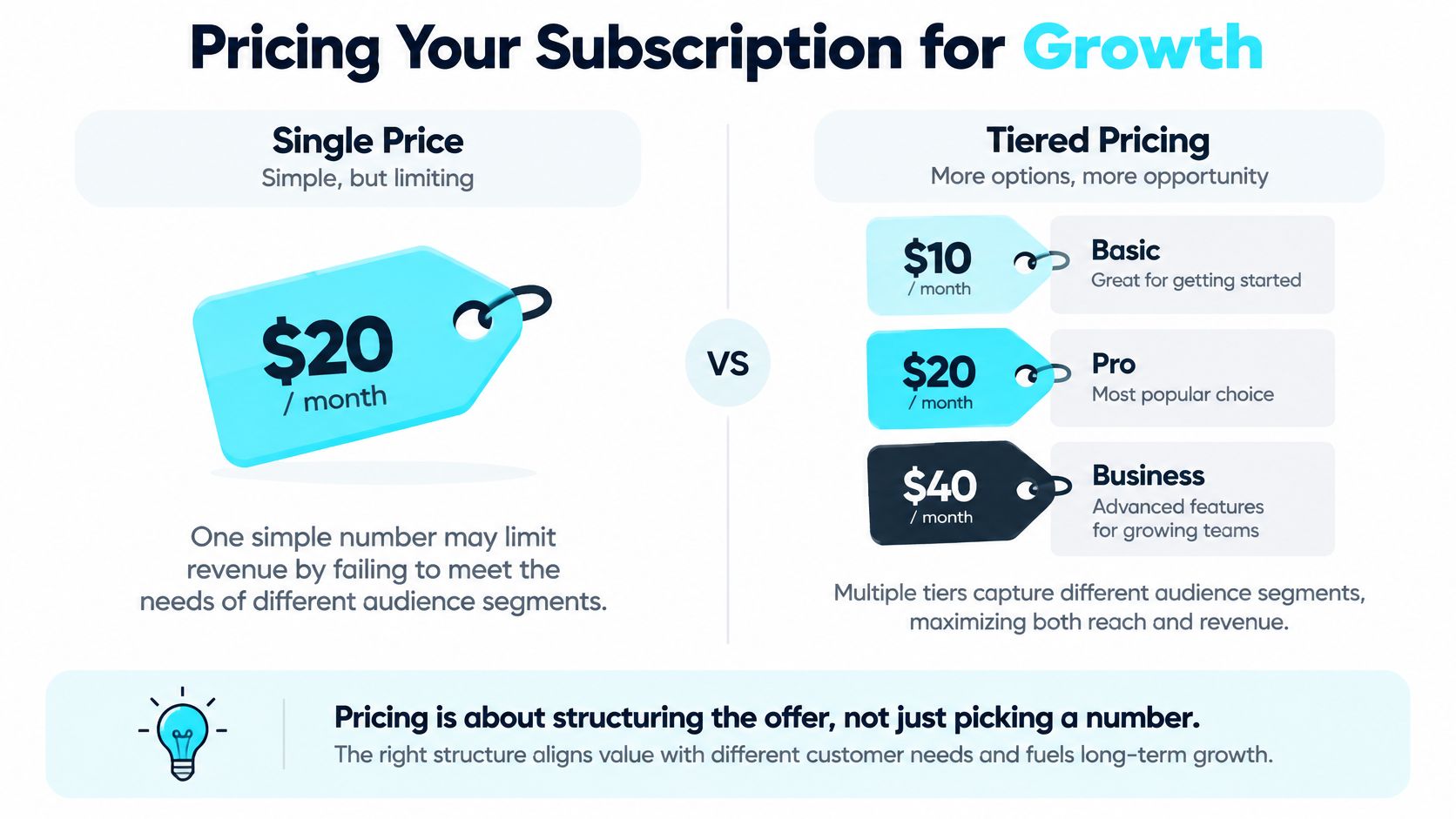
Pricing begins with the offer's structure, not an isolated number. A publisher needs to decide which benefits belong together, which deserve a separate tier, and which create more work than subscribers will value.
The New York Times reported $429 million in subscription revenue in Q1 2024, up nearly 8% year over year, with digital-only revenue increasing more than 13%, supported by bundles combining journalism, games, cooking, product reviews, and sports, according to the company's first-quarter 2024 results. A small publisher can't copy that scale, but can apply the narrower lesson: complementary products can make an offer more useful.
Choose Simplicity Before Adding Tiers
A newsletter, searchable archive, and practical templates may form a coherent bundle. Unrelated extras can make the offer harder to understand and maintain.
Start with a clear core membership. Add tiers only when customers have meaningfully different needs, such as content access versus limited personal support. The guide to tiered pricing for a blog offers a reference for exploring that structure.
For a comparison exercise outside publishing, Disputely's pricing page can serve as another page to inspect for how charges and conditions are presented. The useful task is to assess clarity, not copy another business model.
Annual billing deserves consideration, but not blind preference. A subscription retention benchmark summary reports approximately 27–28% retention at one year for annual app subscriptions versus 11.4% for monthly plans; it also cites merchant analysis separating voluntary churn around 2.5% from involuntary churn around 0.9%. Those datasets aren't forecasts for paid newsletters, and plan selection alone doesn't prove what caused retention.
Make Price Increases Defensible
Price changes test goodwill. Mastercard's subscription-economy research reports that 66% of consumers would stay subscribed for a reduced-price offer.
Before raising prices, conduct a value audit.
Show delivered improvements: Name the reporting, resources, or service changes members received.
State the change plainly: Explain the new charge, effective date, and affected plan.
Offer a credible alternative: Consider limited access, temporary relief, or grandfathered pricing where financially workable.
Segment the notice: Account for tenure, engagement, geography, and existing terms.
A discount can preserve a valuable relationship, but permanent exceptions create administrative work. Fairness requires a policy, not improvised negotiations with whoever complains loudest.
Gating Content and Building Your Paywall
A paywall should protect a defined paid benefit without hiding every reason to trust the publisher. Public work demonstrates quality; paid work delivers the depth, timeliness, or utility promised at checkout.
For example, a specialist publication might leave introductory explainers open while reserving original analysis and maintained resources for members. An archive can support the offer, but its organization matters as much as its size.
Diagnose Exposure Separately From Persuasion
The Digital Pay-Meter Playbook describes research covering more than 500 news organizations, reporting a median monthly stop rate of 1.8% of readership, monthly conversion of 0.5% of unique visitors, a 1.3% stopped-visitor conversion figure for top-decile publishers, and a typical paid-stop-conversion range of 1–2%. These measures use different denominators and shouldn't be treated as interchangeable targets.
The distinction changes what a publisher should fix.
Low stop rate: Inspect whether likely buyers encounter the paid offer at relevant moments.
Low stop-to-paid conversion: Examine the promised benefit, price presentation, checkout, and suitability of the audience.
Higher exposure without stronger retention: Investigate whether the gate attracts purchases that the product doesn't sustain.
More paywall encounters aren't the same as stronger demand.
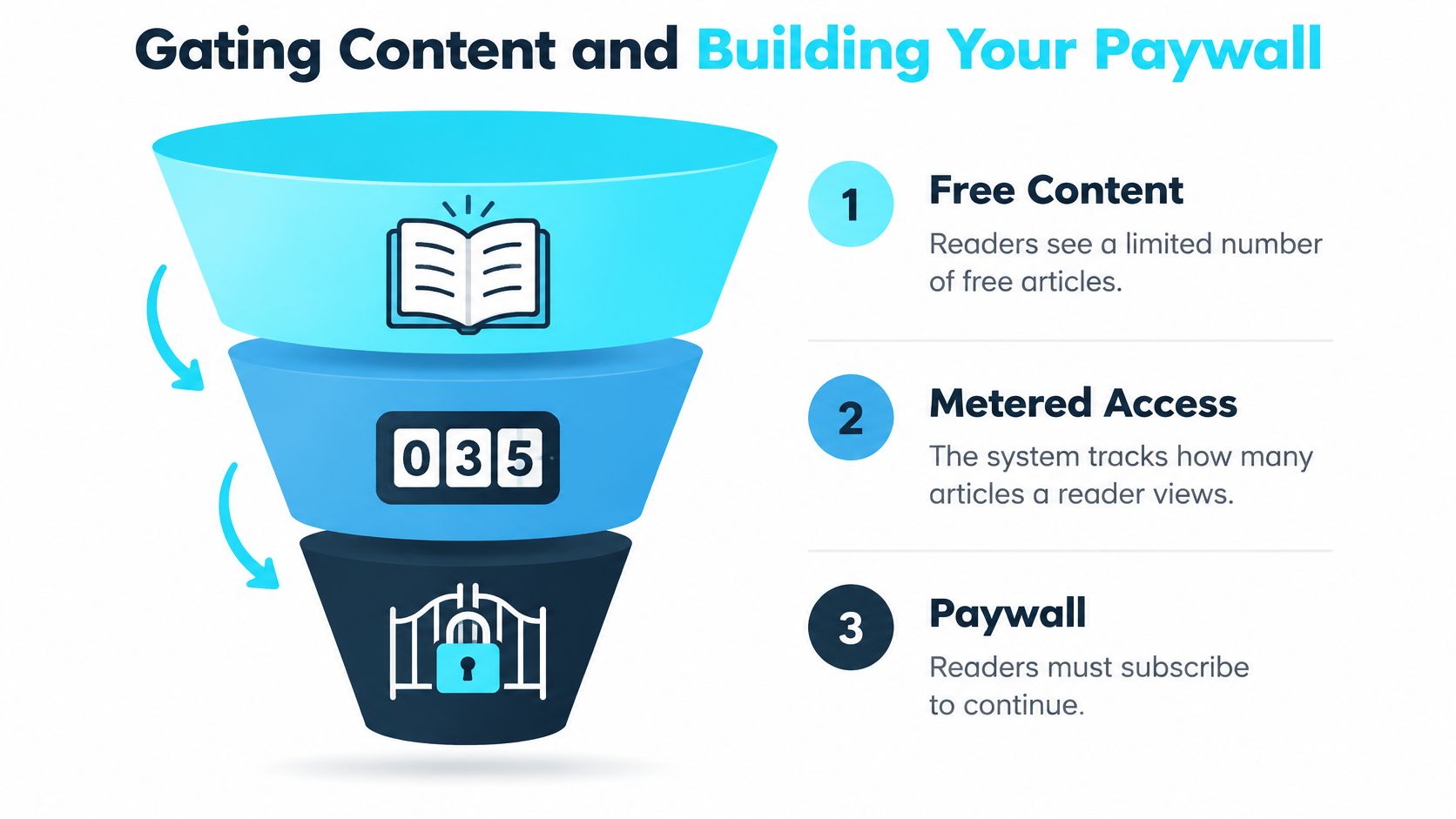
A meter lets readers sample work before committing, while a hard gate makes the access boundary simpler. The trade-off is between providing evidence before purchase and reserving enough distinct value for members.
Make the Access Boundary Reliable
Premium content needs access checks, not just a hidden menu item or an obscured paragraph. The secure paywall guide for a Next.js blog provides a technical reference for publishers using that stack.
At the gate itself, explain what membership grants and provide a visible sign-in route for existing subscribers. Don't force paying readers through an acquisition pitch because their session expired.
Prepare the post-purchase handoff before opening the gate to traffic. The confirmation page should lead directly to the promised content, not return the new subscriber to a blocked article.
Test meter depth and offer wording independently. Changing both together makes it harder to tell whether readers needed more sampling or a clearer reason to buy.
Onboarding New Subscribers in the First 30 Days
Retention starts when payment succeeds. A new member shouldn't have to search for the premium newsletter, decode the archive, or contact support to learn what happens next.
A subscription benchmark report found 86.1% median retention from the first month to the second for non-trial monthly subscriptions, meaning roughly 13.9% didn't remain into month two; churn was highest in the first month, and 80% of first-month churn was active churn. That sample supports treating early experience as an operational priority rather than assuming cancellation is mainly a later problem.
Define a First-Value Event
For a paid publication, activation might mean opening the first premium issue, using a member resource, or finding a relevant archive item. For a publishing-tool subscription, it might mean importing an audience, publishing a post, or sending a newsletter.
Choose an event that reflects the customer's intended outcome. A completed profile is easy to measure, but it may say little about whether a reader received value.
The onboarding sequence should follow behavior.
Immediately after purchase: Confirm the plan and provide a direct route to the promised benefit.
Within 24 hours: Check whether the subscriber completed the first-value event.
Within seven days: Send contextual assistance if activation is missing, rather than repeating the original welcome message.
During the remaining opening period: Introduce useful benefits gradually and ask focused questions when usage stalls.
Send Help, Not an Email Tour
A reader who has already used the archive doesn't need another introduction to it. A member who hasn't opened anything may need a sign-in reminder or a clear starting recommendation rather than a catalogue of benefits.
The SupportGPT retention software insights provide a further resource for evaluating how support and retention workflows can connect. Software selection should follow the events and interventions the publisher intends to manage.
Operational test: Every onboarding message should help a member do something useful or remove a specific uncertainty.
Billing details belong in the welcome experience too. Confirm the renewal terms, explain where account settings live, and make the cancellation route easy to locate.
The objective isn't to exhaust the entire feature list before renewal. It's to help subscribers establish a useful habit without burying them in messages they didn't ask for.
Retaining Subscribers With Flexibility and Fairness
A subscriber who needs a break isn't necessarily a lost customer. Treating every departure as permanent encourages publishers to create cancellation obstacles instead of useful return paths.
Mastercard's subscription-economy research reports that 74% of consumers are more likely to subscribe when cancellation is simple and 31% frequently cancel and later resubscribe; the same research found the ability to pause payments was ranked the most effective retention tactic among U.S. businesses. These findings support testing flexibility, not promising a particular lifetime-value increase.
Match the Alternative to the Reason
A cancellation flow can offer relevant choices without becoming a negotiation trap.
Temporary lack of time: Offer a pause with an explicit restart date and billing explanation.
Budget pressure: Present a lower-access plan if its economics work.
Seasonal demand: Consider access aligned with the customer's working cycle.
Poor product fit: Allow cancellation without requiring a conversation.
Define what happens to access, saved preferences, and communication permissions during each state. A pause that unexpectedly restarts billing can undermine the trust it was meant to preserve.
Treat Compliance as a Launch Check
The FTC's 2024 click-to-cancel rule required express informed consent before charging and a simple cancellation mechanism, but the U.S. Court of Appeals for the Eighth Circuit vacated the rule in July 2025 before it took effect. Other laws, including the federal Restore Online Shoppers' Confidence Act and state auto-renewal laws, still apply, so check current requirements with qualified counsel.
As an operating standard, disclose the price, billing frequency, promotional end date, applicable deadlines, and cancellation method before collecting payment information. Preserve evidence of consent and confirmation of cancellation.
Connect retention reporting to actual account states: active, paused, canceled, and reactivated. Count returning members separately from new acquisitions, and send win-back messages only where permission allows.
A useful return invitation points to a relevant improvement or renewed need. Repeated discounts without a reason to return can train former members to wait for the next offer.
Measuring What Matters and Improving Over Time
Subscription growth isn't a single conversion problem. Publishers need to distinguish audience acquisition, paywall exposure, purchase, activation, renewal, and reactivation before deciding where to spend effort.
The MarketingCharts subscription churn benchmarks report median monthly churn of 5.4% for Digital Media and Entertainment, 3.7% for Software, and 4.4% overall. These are planning references, not promises or automatic performance targets.
Subscription Benchmark Metrics
Metric | Digital Media | Software | Overall |
|---|---|---|---|
Median monthly churn, from the benchmark cited above | 5.4% | 3.7% | 4.4% |
Calculate monthly subscriber churn as subscribers lost during the period divided by subscribers at the start. Keep the period and account-state definitions consistent, particularly when paused memberships are available.
The dashboard also needs distinct acquisition measures.
Monthly stop rate: Unique users stopped by the wall divided by unique visitors.
Paid stop conversion: New subscribers attributable to the wall divided by stopped users.
Visitor-to-paid conversion: New subscribers divided by unique visitors.
Activation: New members completing the chosen first-value event.
Reactivation: Former members who resume paid access, reported separately from first-time purchases.
Segment results by acquisition source, device, geography, content category, and visit frequency. Add plan type, activation behavior, cancellation reason, and recovered failed payments to cohort reporting.
Separate voluntary churn from involuntary churn, following the distinction in the earlier merchant analysis. Assign payment recovery to a named owner who can inspect retry rules, payment-update messages, and access handling rather than treating every failed charge as lost interest.
Test One Decision at a Time
A controlled test needs a specific hypothesis and a downstream check. A shorter meter may increase purchases while attracting members who cancel quickly; an annual-plan presentation may improve upfront receipts without proving stronger engagement.
Test meter depth, offer framing, trial length, and annual-versus-monthly presentation separately. Record the eligible audience, test period, primary measure, and retention guardrail before reviewing the outcome.
Avoid reacting to an isolated strong week. Acquisition mix and publishing topics can change results even when the checkout stays untouched.
Put the Launch in Operational Order
The practical action plan should produce a working subscription journey, not just a published sales page.
Select and evaluate the platform: Use its trial to run the acceptance tests described earlier, including delivery and exports.
Connect payments: Verify the receiving account and the relationship between billing and member access.
Publish the offer: Define the paid promise, billing options, and delivery commitments.
Apply the gate: Confirm that public samples remain useful and premium access behaves correctly.
Activate new members: Implement the first-value event and behavior-based onboarding.
Configure account changes: Test cancellation, pauses, downgrades, and failed-payment recovery where supported.
Establish reporting: Assign responsibility for reviewing cohorts and choosing the next controlled experiment.
Before launch, obtain appropriate advice on disclosure, recurring billing, tax, privacy, and cancellation obligations in the markets served. Technical setup doesn't establish legal compliance.
The first improvement should address the clearest observed failure. Sending more visitors into a broken access flow wastes acquisition effort; rewriting a paywall won't repair weak onboarding.
VeloCMS offers blogging, newsletters, memberships, and site theming in a subscription-based platform for creators and small teams. Publishers considering it to sell digital subscriptions can use the 14-day free trial available with every plan to test their publishing and member journey before committing; there's no free plan.