newsletter vs blog · Oct 27, 2026
Newsletter vs Blog: Which Should You Build First?
The popular advice to “start a newsletter because you own the audience” skips the first question: does anyone have a reason to subscribe yet? A blog gives new readers a public, searchable way to find a publisher; a newsletter gives an opted-in audience a direct reason to return. For most new sites,

The popular advice to “start a newsletter because you own the audience” skips the first question: does anyone have a reason to subscribe yet? A blog gives new readers a public, searchable way to find a publisher; a newsletter gives an opted-in audience a direct reason to return. For most new sites, the blog is the better first asset. For publishers who already have readers they can email, the newsletter may be the stronger first move.
Table of Contents
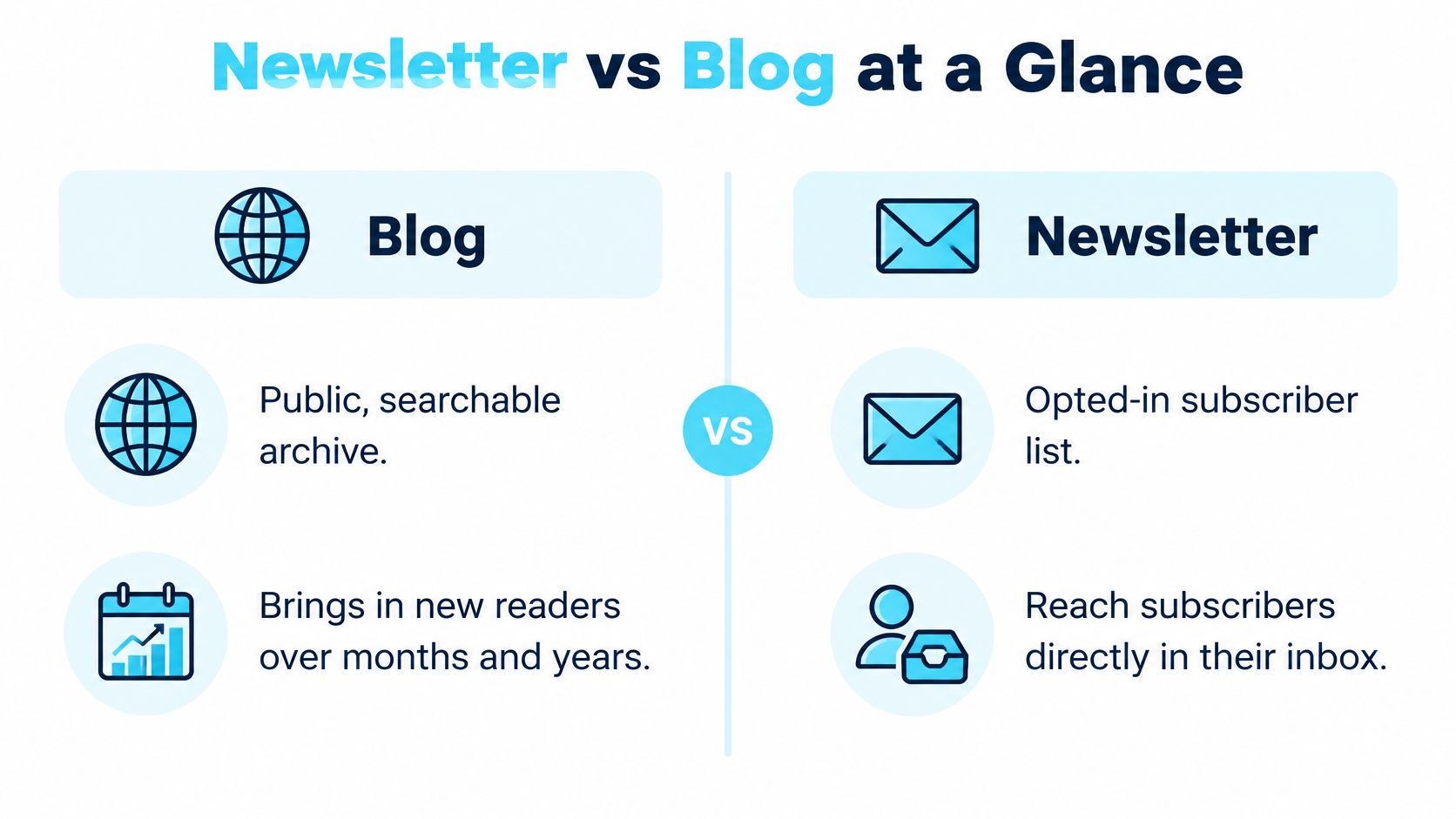
Newsletter vs Blog at a Glance
Start with a blog if new readers are the priority, and start with a newsletter if there's already an audience to email. A blog is a public, searchable archive that can bring in readers over time. A newsletter is an opted-in subscriber list reached directly on a schedule. Neither format wins in every situation.
Criterion | Blog | Newsletter |
|---|---|---|
Who controls the audience | Readers arrive through search, links and social shares; their contact details are usually unknown | Subscribers opt in, so the publisher has their email addresses |
How readers find you | Search, referrals, social sharing and archives | Direct delivery to the inbox on a schedule |
Time to first results | Often months, as posts gain search visibility | Quick once a list exists; list growth is the slow part |
Permanence | Posts stay public and searchable until removed | Each send is a one-time event unless it's also published on the web |
Engagement pattern | Single visits, with some readers returning | Recurring contact with a known audience |
Main revenue paths | Ads, affiliate links, memberships and product sales | Paid subscriptions, sponsorships, memberships and product sales |
Legal duties | Standard website rules | Commercial email rules, including opt-out requirements under CAN-SPAM in the U.S. |
Typical measures | Pageviews, search impressions and engaged sessions | Clicks, unsubscribes, bounces and paid conversions |
Main risk | Traffic relies on search rankings and algorithms | A small list may not reach enough people on its own |
Blogs compound through discovery, and newsletters compound through repeat contact.
The distinction is about what each format can do for a publisher: build an audience that can find content publicly, or bring known readers back through direct delivery. The strongest choice depends on which job is most urgent. The rest of the comparison turns on that difference, from audience ownership and search to measurement and revenue, before closing with a verdict by situation.
Who Owns the Audience and What the Law Requires
Audience ownership isn't a matter of who holds a database, at least not only that. It means whether the publisher can reach a reader again without depending on that reader to rediscover the site. A person who arrives from a search result can read a post and leave without sharing any contact details. If rankings change, a site can lose that source of visits without gaining a way to contact the people who came through it.
A newsletter subscriber has opted in and supplied an email address, which creates a direct channel for new editions, offers and updates. That channel still relies on the subscriber's continued permission, accurate list records and successful delivery. The practical asset is a permission-based relationship, not just a list of addresses.
The U.S. commercial email checklist
The FTC's CAN-SPAM compliance guide requires commercial email to include a clear explanation of how recipients can opt out and a return email address or another easy internet-based method for making that request. Senders must keep processing opt-out requests for at least 30 days after sending and honor them within 10 business days. They can't charge a fee, demand information beyond an email address or require more than replying to an email or visiting one web page.
A practical newsletter setup therefore needs:
A working unsubscribe link that leads to a simple opt-out process.
A suppression list applied to every send, so unsubscribed recipients aren't re-added by mistake.
A compliant footer with the required opt-out explanation and a return email address or easy online method.
These rules apply even when recipients are subscribers or members. A site that only publishes blog articles doesn't need this specific commercial-email workflow. If that site also sends promotional email, the workflow applies to those messages.
Ownership also depends on portability. Exporting posts and subscriber details makes it possible to move the audience and publishing archive if a platform no longer fits. VeloCMS lets customers export posts, media and subscriber lists whenever they want, so content and readers can move with them. For publishers comparing independent newsletter services with hosted platforms, the subscriber-owned newsletter and Substack comparison can help frame the portability question. For email operations, it's also useful to verify your DMARC policy as part of a broader review of sending-domain authentication.
How Each Format Earns Search Traffic
A blog post can be discovered in search after publication. An email issue doesn't automatically appear in search results unless it's also available as a web page. The Google Search guidance on creating helpful content recommends writing primarily for people while making pages easy for search systems to crawl, index and understand. That's why useful answers, clear headings and indexable URLs matter more than publishing often for its own sake.
A blog's search value comes from the specific questions its posts answer and whether search engines can interpret and index those pages. A post that earns visibility can continue attracting readers after its launch, but ranking isn't guaranteed. Publishers should judge search progress over quarters rather than weeks, while still checking whether posts are indexed, attracting impressions and bringing in relevant visitors.
A newsletter issue, by contrast, reaches people through an email list. Publishing an issue on the web can give it a search entry point, but copying the email verbatim to a public page raises a content-management question: are subscribers receiving an editorial product, or just a second delivery of the same page?
Make the archive decision deliberately
Before publishing newsletter issues as web pages, decide:
Which editions become public pages. Some issues may work as public articles, while others are better kept as subscriber-only editions.
Which URL is canonical. When substantially the same text appears at multiple URLs, choose which page should be treated as the main version.
How much to show publicly. An excerpt can let a new visitor assess the issue without making the public archive a duplicate of the email.
How structured data fits the page. Structured data helps search systems interpret article content; it doesn't guarantee rankings.
Search also shouldn't be treated as a guaranteed source of traffic for every publisher: rankings change, and some searches end without a click to any site. That makes a stronger case for combining discoverable content with a permission-based way to reach readers, not for abandoning a blog.
For publishers building a search-led site, VeloCMS includes per-post Article JSON-LD, Open Graph, canonical URLs, reading time and tag filtering. Its guide to SEO and AI search for blog platforms offers a place to compare the technical factors to consider.
Engagement Metrics That Separate the Two Formats
Mailchimp's benchmark data reports an all-user average of 35.63% opens and 2.62% clicks, and describes 2.66% as an optimal click-through rate, with rates ranging from about 1% to 5% depending on industry (Mailchimp's email marketing benchmarks, last updated December 2023). These figures are reference points, not promises for any particular list or campaign.
Open rate is a weak measure of readership on its own. Privacy protections and image caching can record an open without telling the publisher whether a person read the message. Clicks are more actionable, but even they need context: a link click is valuable only if the person takes a meaningful next step.
For example, 10,000 subscribers at a 2.66% click rate produce about 266 clicks before accounting for unsubscribes, bounces and segmentation. That's a planning calculation based on the benchmark, not a forecast of actual traffic or sales.
Metric | Format | What it tells you |
|---|---|---|
Click rate | Newsletter | Share of recipients who clicked a link |
Open rate | Newsletter | Directional interest only, distorted by privacy protections |
Click-to-open rate | Newsletter | Whether the content earned clicks from those who opened |
Unsubscribe rate | Newsletter | Whether frequency or content is losing readers |
Bounce rate | Newsletter | Health of the list and delivery |
Revenue per recipient | Newsletter | Money earned per email sent |
Organic impressions and click-through rate | Blog | Whether search is showing the post and people choose it |
Engaged sessions | Blog | Whether visitors read or interact beyond the first screen |
Signup rate from blog traffic | Both | Whether readers join the list |
Automated security scanners can register clicks, too. Newsletter publishers should check whether traffic leads to session depth, registrations, purchases or replies before treating a click total as evidence of human engagement. The useful question isn't just whether the recipient clicked, but whether that click produced a result the business values.
For blog posts, organic impressions show whether search is surfacing the page, while click-through rate shows whether people choose it in search results. Engaged sessions help distinguish a reader who interacts with the page from someone who leaves immediately. Signup rate from blog traffic connects those visits to the next stage of audience building.
Segment reporting by acquisition source and recency rather than relying on one average. A recent subscriber who found a product guide may behave differently from a long-time reader who joined through a personal essay. Comparisons are clearer when newsletter metrics and blog outcomes are tied to the same audience cohort and business goal.
Monetization and Platform Costs Compared
Blogs and newsletters can both make money, but their commercial roles differ. A blog can earn through advertising, affiliate links, sponsorships, memberships and product sales. A newsletter can sell paid subscriptions, sponsorships and products to a list that has opted in. In either case, gross revenue isn't the same as profit: software, hosting, payment processing, content production and acquisition all affect the result.
Substack's help centre provides a clear paid-newsletter example. It charges a 10% platform fee, while Stripe charges 2.9% plus $0.30 per transaction and a 0.5% billing fee on recurring subscriptions, according to the Substack paid-subscription FAQ. On a hypothetical $10 payment, the platform fee is $1.00, the card fee is about $0.59 and the billing fee is about $0.05, leaving about $8.36 before other taxes or costs.
That calculation shows why platform fees matter: a percentage charge rises with revenue, while a flat subscription fee doesn't increase in the same way as sales grow. Publishers should model expected net income at several subscriber counts and include any recurring-payment fees, taxes, software and production costs. A separate guide to proven strategies for monetizing a blog can help publishers compare revenue paths beyond email subscriptions.
Treat conversion estimates as planning inputs
Substack says that when a publication has a solid open rate of 40% or more, 5% to 10% of subscribers may eventually convert to paid subscriptions. The estimate depends on pricing, subject matter, the value offered and marketing, so it isn't a universal benchmark or guarantee (Substack's finance-writers FAQ). Applied to a hypothetical list of 10,000 subscribers, that range corresponds to 500 to 1,000 paid subscribers over time, not immediately.
This is a planning scenario, not a sales forecast. The blog's job may be to bring in new readers and give them a route to subscribe, while the newsletter gives the publisher repeated opportunities to make a paid offer. Each step needs separate measurement so the publisher can tell whether search visitors are subscribing and whether subscribers are paying.
Platform choice affects the calculation, too. VeloCMS has no free plan, and every plan starts with a 14-day free trial. It doesn't charge an additional monthly subscription for its built-in newsletter beyond the VeloCMS plan. Its current pricing and fee terms are listed on the pricing page, which this article doesn't quote. Publishers comparing it with other options should calculate total costs rather than assuming every service offers the same fee model. A discussion of the real cost of running a WordPress blog can also help bring add-ons and operating expenses into the comparison.
Running a Blog and Newsletter from One Source
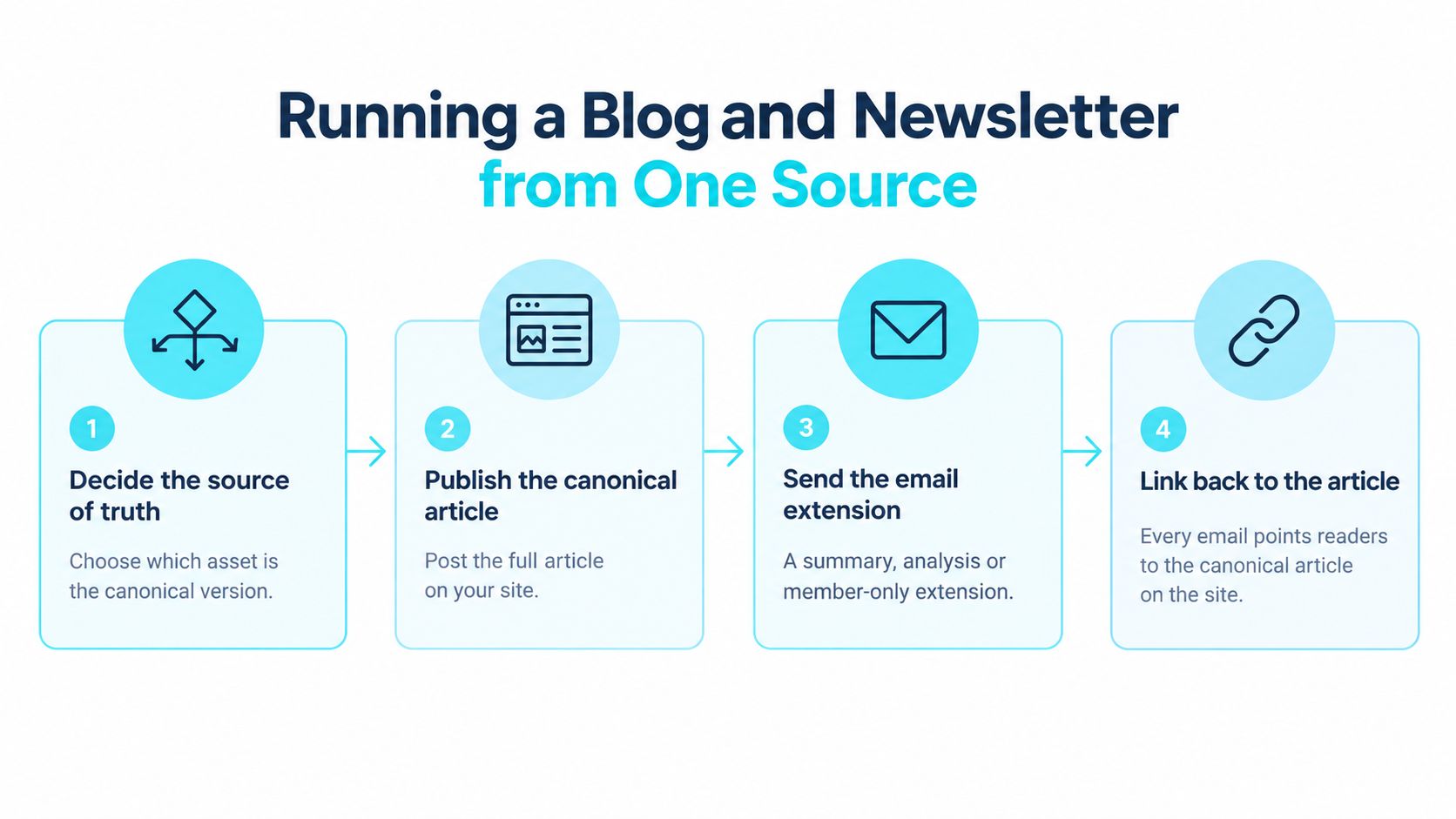
The first publishing decision isn't whether an idea belongs in a blog or a newsletter. It's which asset is the source of truth. For many independent publishers, the clearest arrangement is a canonical article on the site and a differentiated email that summarizes it, adds analysis or offers a subscriber-only extension. The email should give people a reason to open and click, while the website remains the durable public version.
This setup also gives the publisher concrete choices to make before publishing. Should every newsletter issue be archived publicly? If the same text appears in email and on the site, which URL is canonical? Should a public page show an excerpt or the full edition? And if a subscriber later returns through search before buying, how should the business credit that conversion?
Many independent publishers already run both. A MediaPost report on Muck Rack's State of Creator Journalism 2025 survey found that self-publishing creators most often use a personal blog or website (53%) and an email newsletter (41%). The practical lesson is to set content boundaries: the article can carry the full searchable argument, while the email adds a personalized introduction or extra value rather than reproducing the same copy without a clear purpose.
Build a measurable publishing loop
A workflow can be simple:
Publish the canonical post on the website, with a clear URL and a specific reader intent.
Place signup forms near the top and end of the post, so readers can subscribe after seeing the value.
Send a digest or member-only extension that gives subscribers a reason to read the email and visit the article.
Tag readers by source and topic so later campaigns can reflect how they joined and what they read.
Measure paid conversions by source to see which entry points lead to customers, not just visits.
For a worked funnel, say a site receives 100,000 monthly visits and 2% of those visitors sign up, producing 2,000 new subscribers. A subsequent send at a 2.66% click-through target yields about 53 clicks before segmentation. These are illustrative calculations using a hypothetical signup rate and the cited click-through target, not a prediction of results.
Tools can reduce duplicate work when publishing and emailing share a workflow. VeloCMS lets publishers send posts to newsletter subscribers as campaigns from the same admin used to write them, and it includes newsletters, memberships, a store and SEO tools as part of the product. For publishers turning one article into several formats, a step-by-step content repurposing framework can help shape a deliberate adaptation rather than copy and paste. The key is to write down content roles, canonical URL rules and attribution conventions before the publishing cadence begins. Publishers considering VeloCMS can use its platform comparison page to see how its tools fit this kind of workflow.
Choose the Format That Matches Your Audience Stage
Start with a blog when the business needs readers, and start with a newsletter when it already has readers the publisher can reach. The right sequence depends on the gap: a site with no audience needs discovery, while a publisher with regular readers may need a direct route back to them.
Your situation | Lead with | Why |
|---|---|---|
New site with no readers yet | Blog | Search and social can bring first readers; there's no list to email |
Blog with steady traffic and no email list | Add a signup and a newsletter | Turns visitors already arriving into subscribers the publisher can reach |
Existing list that buys or reads regularly | Newsletter as the main channel | Recurring contact supports repeat visits, sales and paid conversion |
Paid subscriptions planned | Newsletter with a paid tier, after fee modeling | Platform fees change net income, so compare them before launch |
Publishing for clients or a small team | Blog and newsletter from one source | One archive and one editorial calendar reduce duplicate work |
A small list can reach fewer people than a well-chosen public article. So a newsletter shouldn't be the first priority merely because the publisher values audience ownership. A public post can test demand with readers who haven't subscribed; a signup offer can then capture the people who want more. A newsletter becomes more useful when there's a clear reason to email subscribers, such as a recurring digest, a product launch or a member-only extension.
For many publishers, a sensible progression is to publish public posts, observe what readers respond to and collect signups. Once the newsletter has an editorial purpose, send on a schedule the team can sustain. Consider a paid tier only when the publisher can measure whether readers are converting and whether the net income justifies the work and fees.
Workload is part of the choice. A newsletter adds a fixed sending schedule on top of writing, while a blog needs a publishing cadence that gives search time to discover its pages. A 2025 survey of creators, authors and business owners found that more than 65% had fewer than 1,000 email subscribers. That makes it risky to assume a new newsletter will immediately be a strong growth engine. Separately, the Muck Rack survey reported by MediaPost found that roughly 43% of creator journalists publish five or more stories per week. A team should decide what it can sustain before committing to both formats.
The immediate next step is to list where current readers come from, count how many can be emailed and model platform costs against expected revenue. If one platform for a blog, newsletter and memberships fits the workflow, VeloCMS offers a 14-day free trial on paid plans and has no free plan, so a publisher can test the setup before committing.
VeloCMS brings blog publishing, newsletters and memberships into one subscription, with a 14-day free trial on paid plans and no free plan. Visit VeloCMS to see whether its publishing tools fit the audience and workflow the business needs.