affiliate marketing newsletter · Oct 19, 2026
Affiliate Marketing Newsletter: A Growth Strategy Guide
A publisher has an engaged email list, useful product recommendations, and affiliate links ready to send, but no clear explanation of how those links become income. An affiliate marketing newsletter can turn relevant recommendations into commission revenue, provided the operator connects audience fi

A publisher has an engaged email list, useful product recommendations, and affiliate links ready to send, but no clear explanation of how those links become income. An affiliate marketing newsletter can turn relevant recommendations into commission revenue, provided the operator connects audience fit, clear disclosure, reliable tracking, and approved conversions. The business isn't just sending more offers. It's knowing which recommendations deserve attention and whether the merchant pays for the resulting action.
Table of Contents
Why Affiliate Marketing Newsletters Are Worth Building in 2026
Affiliate revenue is realistic when subscribers already look to a publisher for help with purchase decisions. A blogging newsletter might recommend hosting, while a small-business publication might compare bookkeeping software. The starting point is a recurring reader problem, not a catalog of products with attractive commissions.
The strongest reason to build this channel is editorial control. An operator can explain a product's limitations, revisit a complicated decision, and organize recommendations around subscriber interests. That makes a newsletter useful even when a reader doesn't buy immediately.
Start with the reader's decision
Before joining programs, the publisher should identify what subscribers are trying to accomplish and what prevents them from acting. A useful offer resolves a specific obstacle rather than introducing an unrelated shopping opportunity.
Identify the recurring problem. Reader replies, support questions, and popular blog topics can guide product selection.
Check buying readiness. A beginner researching website setup needs different recommendations from an agency replacing its existing software.
Set an editorial boundary. An offer shouldn't appear merely because a merchant has launched a promotion.
The publishing environment matters, too. Operators evaluating control over their content and subscriber relationships can use this discussion of subscriber-owned newsletters versus Substack as a decision resource. Platform choice should follow the workflow, not substitute for a strategy.
Practical rule: An affiliate offer should make an issue more useful even if its commission disappears.
This model fits publishers willing to maintain recommendations, inspect reporting, and decline unsuitable offers. It doesn't fit an operation that wants effortless revenue from a neglected list. A modest, focused publication can establish a disciplined process before expanding its commercial calendar.
How the Affiliate Newsletter Model Actually Works
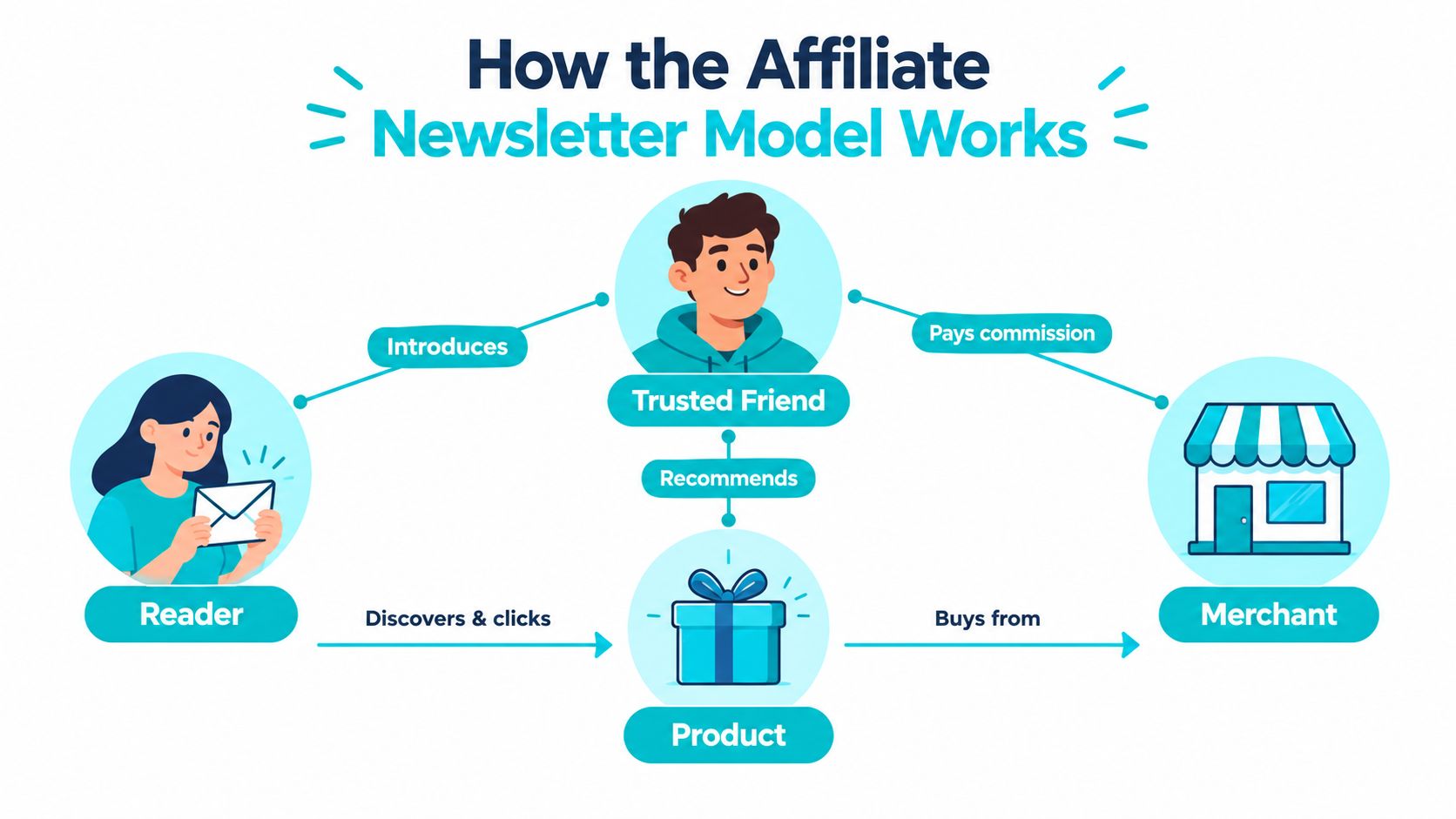
Think of the newsletter as a trusted friend making an introduction. The reader has a problem, the publisher recommends a product, and the merchant pays when that introduction produces an eligible action. The important qualification is eligible: interest alone doesn't establish a payable commission.
Available industry estimates put worldwide affiliate-marketing value at approximately $15.7 billion in 2024, compared with $14 billion in 2023 and $2.9 billion in 2013, representing roughly 441% growth across that period. The same compilation estimates U.S. affiliate spending above $10.7 billion in 2024, according to Whop's affiliate-marketing statistics.
Follow the money, not the impression
A reader clicks a tracked recommendation and reaches the merchant. The merchant or network records the qualifying sale, lead, or other defined action, then evaluates it under the program's terms. The publisher should distinguish recorded activity, approved commission, and received payment in its own reporting.
Program terms deserve scrutiny before publication. Operators should check which actions qualify, how attribution windows work, what can invalidate a commission, and when payment becomes available. A dashboard total shouldn't be treated as money already earned.
For niche publishers, category-specific reading can help frame the selection process. Social Cloud's 2026 supplement affiliate strategies offers a focused resource for operators exploring supplement programs, while each merchant's current terms should govern participation.
Affiliate recommendations also need a different commercial label from other placements:
Affiliate placement. Compensation depends on the program's defined, tracked action.
Sponsored placement. The agreement should specify what the advertiser is purchasing and whether payment depends on results.
Display advertising. An ad slot shouldn't be presented as an independent editorial recommendation.
The publisher's job is to keep those arrangements distinguishable. Readers should understand the recommendation, and the operator should understand the payment contract behind it.
Setting Up the Affiliate Stack Behind Your Newsletter
A newsletter tool isn't the entire affiliate stack. The operator also needs approved programs, a maintained offer register, a link-management process, and a publishing workflow that can reproduce the same checks for every issue. Buying more software before defining those responsibilities usually adds work.
Build an offer register first
Program applications should describe the publication truthfully: its subject, audience, distribution channels, and proposed promotional approach. Approval shouldn't be assumed, and a merchant's permission to promote on a website shouldn't be treated as permission to promote through email.
The register can live in a spreadsheet or another shared workspace. Its purpose is to make commercial terms available when an editor chooses an offer.
Program permissions. Record whether email promotion, redirects, coupons, and the proposed content format are permitted.
Commercial terms. Store qualifying actions, attribution conditions, approval rules, payout requirements, and the contact responsible for disputes.
Editorial evidence. Keep testing notes, product documentation, known limitations, and the reason the product fits the audience.
Maintenance status. Record broken destinations, expired promotions, changed terms, and offers awaiting review.
This register separates product suitability from commission attractiveness. A high payout shouldn't compensate for poor reader fit or unclear program rules.
Keep the delivery workflow manageable
A redirect or link manager should provide a maintained destination for each offer and placement. Operators should confirm that the program permits the chosen method and test the complete journey through an actual delivered email. A shortened URL isn't evidence that tracking works.
Segmentation should reflect meaningful reader needs. A publication covering business software might separate first-time buyers from readers evaluating replacements, provided its subscriber data supports that distinction. Broad interests shouldn't be mistaken for permission to send unrelated promotions.
A consolidated publishing platform can reduce handoffs between blog editing, subscriber tagging, and email delivery. Separate systems can also work well when responsibilities are clear; migration support and export options belong in the evaluation rather than being assumed.
For an operation considering Tapfiliate, the affiliate connection setup guide is a relevant implementation reference. The final acceptance test remains practical: an editor can select an approved offer, create the tagged placements, render the issue, and verify the destination without improvising the process.
Content Formats That Convert in an Affiliate Newsletter
Format should follow the reader's decision. Someone choosing between familiar products needs a comparison; someone encountering a category for the first time needs an explanation. A discount announcement won't solve confusion about whether the product belongs in the reader's workflow.

Match the format to intent
Single-product review. Use a subject line naming the product and the problem it addresses. Open with the reader's task, explain the evaluation method, cover strengths and limitations, then place the recommendation link after the verdict.
Head-to-head comparison. Frame the subject around a choice, such as accounting software for a small service business. Organize the body by decision criteria, not separate promotional descriptions, and attach each link to the relevant conclusion.
Curated roundup. Give each product a distinct job. A first-time blogger's shortlist might cover hosting, email publishing, and image editing without pretending that those tools compete.
Timed deal alert. Lead with the verified promotion and its audience fit. State restrictions and the confirmed expiration conditions before a CTA inviting readers to check eligibility.
Use-case recommendation. Start with a workflow, such as collecting client approvals. Explain the obstacle, show how a suitable tool could address it, and link where the product becomes necessary to the proposed solution.
For a hosting recommendation, the body should distinguish beginner requirements from advanced needs rather than declaring one provider universally superior. A software comparison for small teams should explain which workflow favors each option. A deal alert should still make sense after the discount is removed.
Establish a written selection policy
Product reviews need evidence, not borrowed enthusiasm. Editors should distinguish hands-on testing from document-based evaluation, verify coupon terms, and explain whether compensation influenced selection or prominence. AI-assisted drafts should undergo the same claim checks as manually written copy.
Coupon and deal content is a common part of affiliate publishing, so a discount deserves the same verification as the product it accompanies: confirm the code, its expiry and any eligibility limits before the issue goes out.
A useful discount belongs inside a recommendation. It shouldn't replace the reason for making one.
Operators should test formats against reader intent and approved revenue, while watching replies and unsubscribe patterns for signs that commercial content has become less useful.
Disclosure, Compliance, and Trust You Can Audit
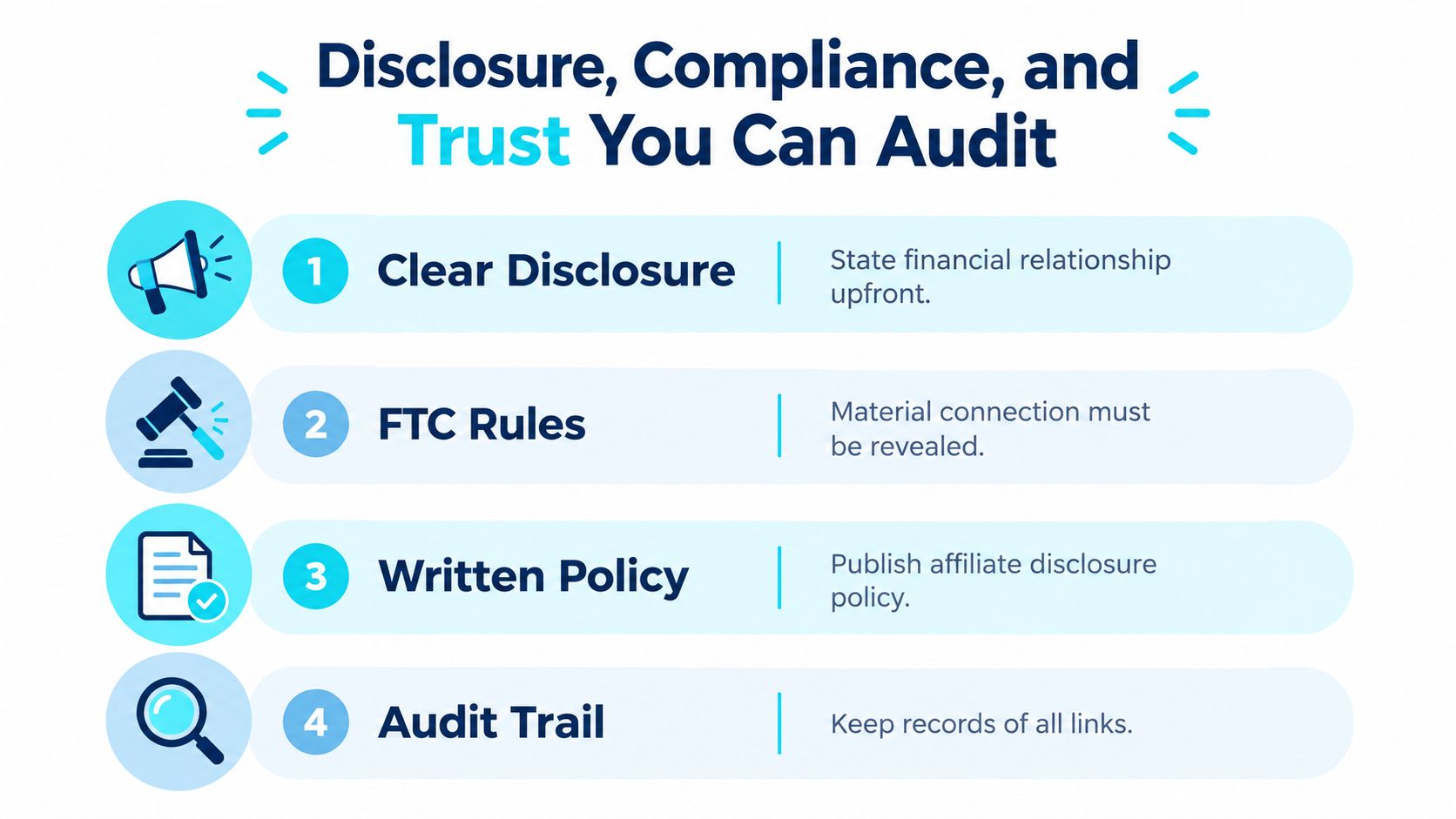
Disclosure belongs in the production system, not in an editor's memory. Under the FTC's endorsement guidance, a connection should be disclosed clearly and conspicuously when a significant minority of consumers wouldn't expect it and it could affect their evaluation of the endorsement. The language should be clear, unambiguous, and present within the same content as the recommendation.
A suitable third-person disclosure is: This email contains affiliate links, and a commission may be earned if a purchase is made through them. It describes the relationship directly. A vague label such as “partner” doesn't provide the same explanation.
Put visibility into the template
For a multi-offer issue, the disclosure should appear before the first monetized recommendation and remain readable on mobile. Relying on a footer, separate webpage, or hidden click-through notice creates avoidable visibility problems, as discussed in Matt McWilliams's affiliate-disclosure guidance.
Reusable disclosure block. Include the approved language in the affiliate email template and inspect its position after layout changes.
Visible unsubscribe control. Place the opt-out where recipients can find it without navigating an elaborate footer.
Rendering checks. Test delivered messages in the email clients used by the audience, including mobile views.
Audit record. Retain the approved template, final message, destination links, and evidence supporting promotional claims.
Treat opt-out as a working feature
Under the FTC's CAN-SPAM compliance guide, commercial messages require a clear opt-out method, requests must be honored within 10 business days, and the mechanism must process requests for at least 30 days after sending. Recipients must be able to stop all marketing messages, even when category preferences are also offered.
The guide states that each violating email can carry a civil penalty of up to $53,088. Accurate sender information and a tested unsubscribe process therefore belong in the release checklist, not an occasional compliance review.
For footer organization, CleanMyList's guide to email footers for senders provides an additional design reference. A footer can support compliance, but it shouldn't carry the entire disclosure burden. Operators outside the United States should also check the rules applicable to their recipients rather than treating U.S. guidance as a universal standard.
Tracking Clicks and Conversions With UTMs and Sub-IDs
UTMs describe the campaign; affiliate identifiers establish the referral record. Neither should be treated as a substitute for the other. Operators should preserve the network's tracking fields while adding campaign tags only in the way the program supports.
Google recommends using utm_source, utm_medium, and utm_campaign for manually tagged campaign URLs in its campaign-parameter documentation. Consistent values matter more than elaborate names.
UTM Parameters for Affiliate Newsletter Links
Parameter | Purpose | Example value |
|---|---|---|
| Identifies the sender or referrer |
|
| Identifies the marketing medium |
|
| Identifies the issue or promotion |
|
| Distinguishes link placements |
|
Google's traffic-source dimension guidance explains how campaign parameters identify referred traffic and how utm_content can distinguish similar links. The complete URL should be tested after redirects, with both the affiliate identifier and analytics parameters intact. UTMs don't automatically give a publisher access to a merchant's analytics.
An edition-level sub-ID can connect approved commissions to an issue, while a placement identifier separates the opening button from an inline recommendation. Where supported, a unique click ID allows more precise matching between a referral and the merchant's conversion record.
Reconcile the complete funnel
The operator should compare delivered-email clicks, redirect or link-manager clicks, and approved affiliate conversions. Those datasets describe different stages, so disagreements should trigger investigation rather than an assumption that one dashboard is correct.
Weak click response. Inspect offer relevance, editorial context, and placement.
Clicks without approved conversions. Examine the destination, pricing, device experience, merchant quality, and program eligibility rules.
Conflicting totals. Check reporting periods, identifier handling, approval delays, and whether each system counts the same event.
Email privacy features can obscure open data, making click-based identity more useful for affiliate diagnosis. Reditus's newsletter-affiliate guidance notes that click-through rates on relevant offers commonly land between 1 and 5 percent of recipients in engaged niche B2B newsletters; treat that as context, not a target, because performance varies by intent and offer fit.
The affiliate click-reporting guide is relevant when reviewing publisher-side activity. For interpreting contribution rather than just counting events, Otter A/B's explanation of how to measure marketing value provides further context.
Getting Paid for Influence Beyond the Last Click
A newsletter can introduce a product, explain its value, and prompt research without receiving the final referral before purchase. A last-click dashboard can therefore under-credit editorial influence. That possibility deserves measurement, but it isn't permission to count every later purchase as newsletter-generated revenue.
An IAB Australia industry review found that 97% of advertisers and agencies allocate commission to the last referring affiliate at least sometimes, while only about one-third use first-click or custom attribution.

Separate influence from payable revenue
Those findings justify a broader view of contribution, not a claim that every newsletter is underpaid. An individual publisher needs evidence from its own audience and cooperation from merchants willing to share relevant information.
Dedicated landing pages. Use an issue-specific page or approved merchant destination to identify newsletter-origin journeys.
Post-purchase surveys. Where merchant cooperation allows, ask purchasers which content helped their decision, including options beyond the newsletter.
Assisted-conversion reporting. Record a newsletter interaction followed by a later purchase separately from commission-bearing transactions.
Repeat-purchase analysis. Examine repeat buying only where authorized data makes it possible to connect those purchases.
Incrementality checks. Where feasible, compare exposed and unexposed audiences rather than assuming that every tracked buyer needed the recommendation.
The useful reporting framework separates last-click commission, observed assists, merchant-confirmed repeat purchases, and the publisher's own subscriber lifetime value. Assisted revenue should be labeled as such, with its measurement method attached. It shouldn't be added to commission revenue in a way that double-counts the same purchase.
Commercial boundary: Evidence of influence can support a better agreement. It doesn't change the existing agreement by itself.
An operator with credible evidence can ask a merchant about alternative attribution, dedicated codes, or a different compensation arrangement. The merchant still needs to approve the terms. Until then, broader measurement should improve partner selection and editorial decisions without overstating what the publisher will receive.
Your First 30 Days With an Affiliate Newsletter
The first month should produce a repeatable issue and a reconciled result, not a large promotional calendar. A small operator can begin with three to five audience-matched programs and deepen the relationships that prove operationally sound. That range is a launch recommendation, not a revenue benchmark.
A manageable launch rhythm
Week one. Complete program applications, build the offer register, choose a permitted link-management method, and approve the email template. Confirm sender identity, opt-out behavior, and the campaign-naming convention.
Week two. Publish the first affiliate issue and test two editorial formats across suitable sends or audience groups. Keep the offer rationale explicit so format differences don't conceal unrelated product choices.
Week three. Reconcile email clicks, redirect records, and approved conversions. Inspect delivered messages across clients and document any tracking or disclosure failures.
Week four. Review available assisted-conversion evidence, reader feedback, and payment status. Decide which program merits another issue and which should pause.
Finish with an operating decision
The operator should retain a concise record of what happened: the offer, intended audience, format, observed response, approved commission, unresolved discrepancy, and next action. That record is more useful than a screenshot of a favorable dashboard total.
Expansion should follow a demonstrated workflow. A program that attracts clicks but creates unresolved payment problems needs investigation, while a relevant recommendation with clean reporting deserves continued editorial attention. The next month should strengthen the working process rather than merely increase sending volume.
VeloCMS offers blogging, newsletters, subscriber segmentation, and native email delivery within a subscription-based content platform, making it an option for operators who want fewer publishing handoffs. Publishers can visit the site to assess that workflow for an affiliate newsletter; there's no free plan, and every plan starts with a 14-day free trial.